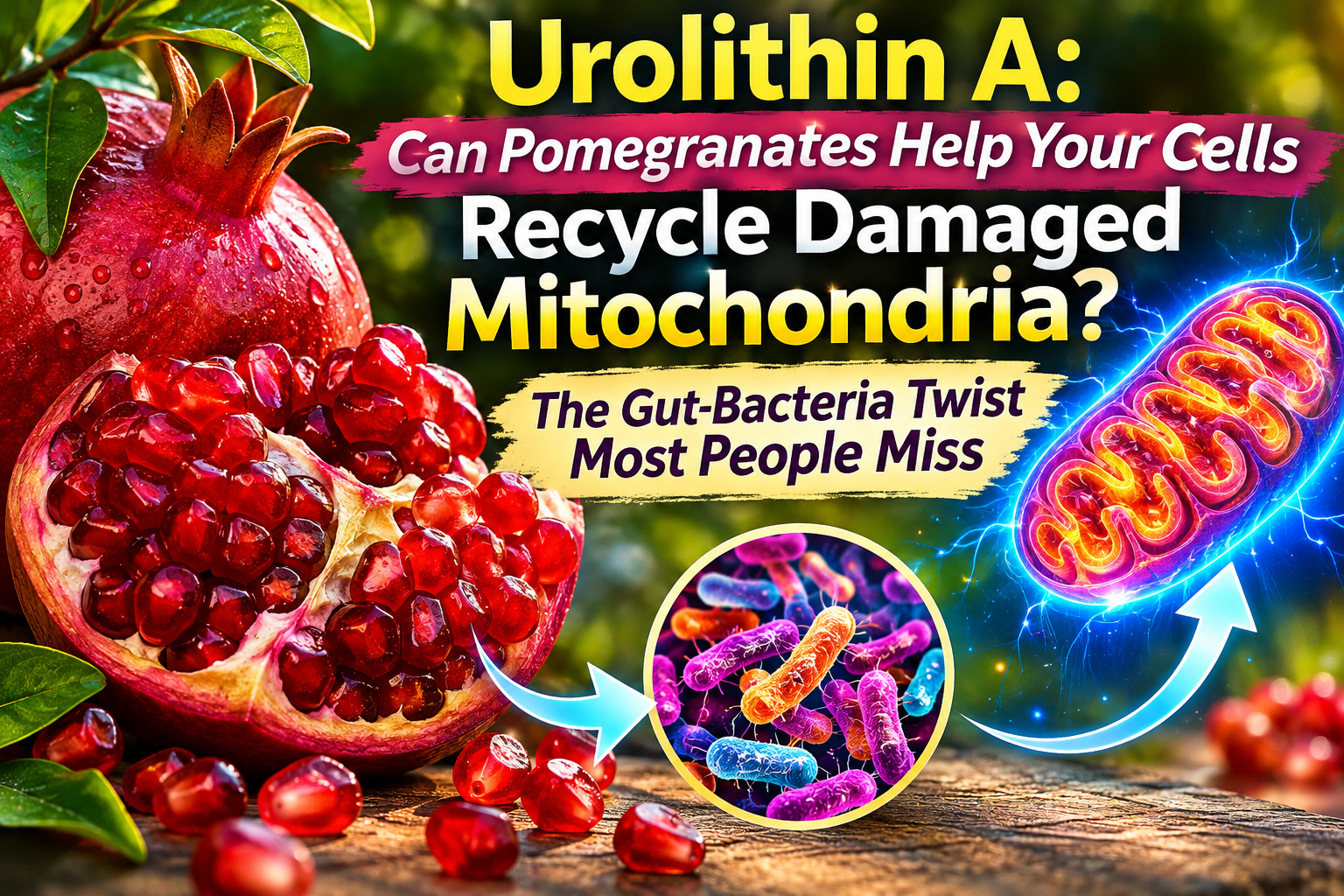
Urolithin A: The Surprising Connection Between Pomegranates and Your Cells
Urolithin A has become an interesting subject in mitochondrial health research, but there’s something about it that many people don’t realize. You won’t find Urolithin A sitting inside a pomegranate, waiting for your body to absorb it. Instead, certain bacteria living in your gut can produce this compound from substances found in pomegranates, walnuts, and some berries. That difference matters more than you might think. Two people can eat the same food, in the same amount, and end up producing very different quantities of Urolithin A. Some people may produce almost none.
What makes this particularly interesting is the connection to a cellular recycling process called mitophagy. Our cells rely on mitochondria to help produce energy, but those mitochondria also need regular maintenance. As they age or become damaged, the body has ways to repair, recycle, or replace them. Researchers are investigating whether Urolithin A can influence that process and what it might mean for muscle function and healthy aging. The science is promising in some areas, uncertain in others, and much more interesting than the usual claims about boosting energy.
Urolithin A and Mitochondrial Health: More Than Energy Production
Most of us learned that mitochondria are the powerhouses of our cells. That’s accurate, but it leaves out much of what they actually do. Mitochondria help convert nutrients into ATP, the energy our cells use to carry out their daily work. They also participate in calcium regulation, cellular communication, and signals that help determine whether damaged cells survive. These functions influence everything from muscle activity to the way cells respond to stress. When mitochondrial health begins to decline, the consequences can extend well beyond feeling tired.
Mitochondria naturally produce reactive oxygen species during normal metabolism. In appropriate amounts, these molecules help cells communicate and adapt to changing conditions. Problems develop when their production overwhelms the body’s protective systems, allowing oxidative stress to damage proteins, fats, and DNA. A 2025 review of mitochondrial dysfunction¹ examines how this damage can interact with inflammation and aging. One particularly interesting finding involves mitochondrial DNA escaping into parts of the cell where it doesn’t belong. The immune system may interpret that misplaced DNA as a danger signal, potentially contributing to inflammatory activity.
How Your Cells Maintain Mitochondrial Health
Think about equipment you depend on every day. You wouldn’t expect it to run indefinitely without maintenance, and you certainly wouldn’t wait for every component to fail before making repairs. Our cells face a similar challenge with mitochondria, although their maintenance systems are far more sophisticated than anything we could design for a workshop. They constantly assess damage, redistribute components, remove material that no longer functions properly, and support the production of new mitochondrial structures. Scientists refer to these coordinated activities as mitochondrial quality control.
Several processes contribute to that maintenance. Fusion allows mitochondria to join and exchange contents, while fission divides them and can help separate damaged portions from healthier ones. Biogenesis supports mitochondrial renewal, and mitophagy removes mitochondria that need recycling. Research on mitochondrial maintenance in skeletal muscle² explores how these processes change with aging, exercise, and periods of inactivity. What caught my attention was how dependent they are on one another. Removing damaged mitochondria accomplishes little if the cell cannot maintain enough healthy ones to meet its energy requirements.
Mitophagy: The Cellular Cleanup Crew
Mitophagy is a specialized form of autophagy, the process cells use to break down and recycle certain cellular components. In this case, the targets are mitochondria that have become damaged or are no longer needed. Once cellular machinery identifies a mitochondrion for removal, it can direct that mitochondrion toward a lysosome. Lysosomes contain enzymes that break down cellular material so the cell can reuse many of its components. It’s an extraordinary recycling system, especially when you consider how much work takes place inside a single cell.
One of the best-studied mitophagy pathways involves two proteins called PINK1 and Parkin. When a mitochondrion loses the electrical potential that helps it function, PINK1 can accumulate on its outer surface and help recruit Parkin. Parkin then participates in marking mitochondrial proteins, helping other cellular machinery recognize the damaged structure. The research on PINK1 and Parkin³ has been particularly important in understanding mitochondrial quality control and its relationship to Parkinson’s disease. Other proteins, including BNIP3, NIX, and FUNDC1, also help regulate mitophagy under different conditions. The body has more than one way to manage this work, and those pathways respond differently depending on the tissue and the stresses it encounters.
Urolithin A: Why Your Gut Bacteria Make All the Difference
Now we come to the part of this story that fascinates me most. Pomegranates contain compounds called ellagitannins, which can release ellagic acid during digestion. Certain intestinal bacteria can then transform these compounds through several steps, eventually producing urolithins. Urolithin A is one of those metabolites, and researchers have become particularly interested in its potential influence on mitochondrial function. Bacteria associated with this process include members of the Gordonibacter group, although several microorganisms can participate in different stages of the conversion. Your gut microbiome determines much of what happens after you eat the fruit.
Researchers classify people into three groups called urolithin metabotypes⁴, based on the urolithins their gut bacteria produce. Metabotype A primarily produces Urolithin A. Metabotype B produces Urolithin A along with other urolithins, while metabotype 0 produces little or no detectable final urolithins. Studies have identified differences among populations, and researchers continue investigating how diet, age, and changes in the microbiome influence these patterns. What I find remarkable is that eating a food doesn’t guarantee your body will produce every potentially beneficial compound associated with it. The same plant can lead to different metabolic results in different people.
Urolithin A and the Surprising Flexibility of Cellular Repair
Mitochondrial maintenance has another feature that deserves attention. Cells don’t always have to destroy an entire mitochondrion because one portion becomes damaged. Scientists have identified tiny structures called mitochondria-derived vesicles, or MDVs, that can transport selected mitochondrial materials to other cellular compartments. Imagine discovering one damaged board on your porch. You would replace the board rather than tear down the entire structure. Certain mitochondrial quality-control pathways accomplish something similar, although the cellular mechanisms are considerably more complicated.
Research on mitochondria-derived vesicles⁵ suggests that they help cells manage selected damaged components without necessarily removing the entire mitochondrion. A separate 2026 study in Nature Cell Biology⁶ investigated how certain mitochondrial vesicles contribute to processes involving damaged lysosomes. Researchers identified a connection between these vesicles and the membrane changes that help lysosomes respond to injury. That finding caught my attention because lysosomes are central to cellular recycling, including mitophagy. The structures responsible for breaking down damaged material may themselves depend on assistance from other cellular systems. Scientists are still exploring these mechanisms, but they reveal how closely cellular repair processes interact.
Why More Mitophagy Isn’t Always Better for Mitochondrial Health
Here’s where I think the wellness conversation sometimes gets ahead of the science. If mitophagy helps remove damaged mitochondria, it seems reasonable to assume that increasing mitophagy would always improve mitochondrial health. Unfortunately, biology doesn’t follow that kind of simple rule. A cell needs to remove damaged mitochondria while maintaining enough functioning mitochondria to meet its energy requirements. If removal outpaces replacement, the cell could lose mitochondrial capacity. The goal is effective maintenance, not simply making one recycling pathway work as hard as possible.
A review of mitochondrial function in aging muscle⁷ examines the relationship between mitochondrial changes and declining muscle function. Researchers have identified several pathways involved in mitochondrial renewal, including signaling associated with PGC-1α, which helps coordinate responses to changing energy demands. Aging can affect how these systems respond, although the changes differ among individuals and tissues. This is one reason I hesitate when a supplement advertisement promises to activate mitophagy without explaining what researchers actually measured. Urolithin A may influence mitochondrial quality control, but that doesn’t mean everyone needs more mitophagy or that increasing it automatically produces better health.
What Happens When Mitochondrial Cleanup Falls Behind?
As we age, some cells become less efficient at maintaining their mitochondria. Damaged mitochondria may accumulate, interfere with normal energy production, or contribute to excessive oxidative stress. Researchers are also investigating how mitochondrial dysfunction interacts with cellular senescence, a state in which certain cells stop dividing but remain metabolically active. Some senescent cells release inflammatory substances that affect surrounding tissues. A review of mitochondrial dysfunction and aging⁸ examines these relationships and the ways cellular damage and inflammation may reinforce one another. These processes don’t explain every change associated with aging, but they represent an important part of the research.
Two inflammatory signaling systems receiving considerable attention are cGAS-STING and the NLRP3 inflammasome. Both participate in normal immune responses, yet prolonged or inappropriate activation can contribute to inflammation. Mitochondrial damage may influence these pathways, particularly when mitochondrial components appear in places where cells interpret them as warning signals. Lysosomes also matter because they must complete the breakdown of cellular material after the cell identifies it for recycling. When their function declines, the cleanup process may become less efficient. That means researchers need to examine the entire maintenance system rather than focus exclusively on the first step of mitophagy.
Can Movement Support Mitochondrial Health?
After spending October exploring movement, I couldn’t ignore its connection to mitochondrial health. Every time we walk, squat, lift something, or challenge our muscles, we change their energy requirements. Those demands trigger cellular signals that help the body adapt to physical activity. Exercise can influence mitochondrial function, renewal, and quality control, although the responses vary with the type of activity and the person performing it. Resistance training and walking place different demands on the body, and both can contribute to physical function in ways that matter as we age. Consistency and appropriate recovery also influence how well we adapt.
A 2026 review of exercise and mitophagy⁹ discusses how physical activity may affect mitochondrial recycling in aging skeletal muscle. Researchers describe differences associated with exercise intensity, duration, muscle characteristics, and age. That makes sense when you consider how differently our bodies respond to the same workout. The strength training, mobility work, and everyday movement we discussed in October may influence processes that we cannot directly observe. We have substantial evidence that appropriate exercise supports strength and physical function. Measuring exactly how much mitophagy a particular exercise session produces in an individual person remains much more difficult.
Mitochondrial Health, Sleep, and Your Internal Clock
Sleep introduces another interesting piece of the mitochondrial health story. Our circadian rhythm helps coordinate daily changes in metabolism, hormone activity, sleep, and other physiological functions. Mitochondria respond to some of these timing signals, while cellular energy metabolism can also influence the body’s internal clock. Research on the biological clock and mitochondria¹⁰ explores this relationship, including how circadian regulation interacts with mitochondrial function. Scientists continue investigating whether disruptions to these rhythms contribute to changes in cellular maintenance. That doesn’t mean one restless night damages your mitochondria, and it certainly doesn’t mean we can measure mitochondrial health by how refreshed we feel in the morning.
I know that maintaining a perfect sleep schedule isn’t realistic for everyone. Work responsibilities, family needs, pain, and ordinary life can interfere with even the best intentions. Still, observing your own patterns can reveal useful information. You may notice differences in energy, exercise tolerance, or recovery after several nights of consistent sleep. Those observations cannot tell you whether mitophagy has increased or decreased, but they can help you understand how your daily habits affect the way you feel and function. Sometimes those personal patterns raise questions worth exploring further.
Urolithin A Supplements: What Does Human Research Actually Show?
This is the part I consider especially important. Laboratory research has identified several interesting effects of Urolithin A on cellular processes, including pathways associated with mitochondrial quality control. Animal studies have provided additional information, but neither type of research guarantees the same results in people. Human studies must account for absorption, dose, metabolism, individual health differences, and the outcomes researchers choose to measure. A review of emerging mitochondrial therapies¹¹ discusses the possibilities of targeting mitochondrial dysfunction while acknowledging the limitations of translating laboratory discoveries into practical treatments.
A 2026 systematic review and meta-analysis of Urolithin A trials¹² examined five randomized studies involving 236 participants. Researchers could combine results for only one outcome, the six-minute walk test, using data from two trials. The pooled results favored Urolithin A, but the difference was not statistically significant, and the researchers rated the certainty of evidence as low. Other findings involving muscle strength, endurance, and mitochondrial markers varied too much for reliable pooled conclusions. I find Urolithin A interesting, especially because of its connection to botanical compounds and gut bacteria. But interesting mechanisms and encouraging early findings aren’t enough to establish that a supplement will improve muscle function or slow aging.
Becoming the Historian of Your Own Mitochondrial Health
One thing I want readers to understand is that we cannot look in the mirror and determine how efficiently our mitochondria recycle damaged components. Feeling tired doesn’t establish mitochondrial dysfunction, and having more energy doesn’t prove that mitophagy has improved. Researchers use specialized techniques to study these processes, and measuring mitophagy reliably in living humans remains challenging. What we can do is pay attention to patterns in our daily lives. Sleep quality, movement, energy, recovery, and changes in physical function can provide useful observations, even though none of them directly measures mitochondrial health.
This is one reason I place so much value on keeping a health journal. Recording your experiences over time may help you recognize connections that are easy to overlook when you’re busy living your life. Perhaps you notice that your recovery changes when your sleep schedule shifts, or that regular movement makes certain daily activities feel easier. You don’t have to document every minute of the day to learn something useful. Start with the patterns that matter most to you and pay attention to how they change. Your observations won’t replace scientific measurements, but they can help you ask better questions and understand your own health history.
The Bigger Picture of Urolithin A and Healthy Aging
The more I learn about mitochondrial health, the less interested I become in the idea of one miracle solution. Our cells depend on coordinated systems that identify damage, recycle materials, support renewal, and respond to changing demands. Researchers continue investigating how those processes influence aging, particularly in tissues such as skeletal muscle that depend heavily on mitochondrial function. A review of mitochondrial dysfunction in aging skeletal muscle¹³ explores how cellular energy production and repair mechanisms relate to muscle maintenance and regeneration. The science is still developing, and many questions remain about how laboratory findings translate into meaningful changes in human health.
For me, that’s what makes this subject so fascinating. Something as familiar as a pomegranate can lead us into a discussion about gut bacteria, cellular recycling, and the remarkable ways our bodies maintain themselves. Yet the most important lesson may be how differently each person responds to the same food. Our biology reflects interactions among our cells, our environment, and the microorganisms living within us. Understanding those relationships gives us another way to think about health without turning every new discovery into a promise. There is still so much to learn, and I think that’s part of what makes the research worth following.
Your body has a story to tell. Learn how to become the historian of your own health using my journal.
If you’d like help exploring your health patterns and developing practical steps that fit your life, visit Work With Charlotte to learn about my consultations and personalized guidance.
Herbally and Holistically yours,
Charlotte Lange, CNC
CPL Holistics | CPL Botanicals
References
- Xu X, Pang Y, Fan X. Mitochondria in oxidative stress, inflammation and aging: from mechanisms to therapeutic advances. Signal Transduction and Targeted Therapy. 2025;10:190.
https://pubmed.ncbi.nlm.nih.gov/40500258/ - Kuznyetsova, et al. Mitophagy in skeletal muscle: Impact of ageing, exercise and disuse. Experimental Physiology.
https://physoc.onlinelibrary.wiley.com/doi/10.1113/EP093041 - Narendra D, Walker JE, Youle R. Mitochondrial Quality Control Mediated by PINK1 and Parkin: Links to Parkinsonism. Cold Spring Harbor Perspectives in Biology.
https://cshperspectives.cshlp.org/content/4/11/a011338.full.pdf - Urolithin A production drives the effects of pomegranate on the gut microbial metabolism of bile acids and cholesterol in mild dyslipidaemic overweight and obese individuals. Food & Function. 2024.
https://pubs.rsc.org/en/Content/ArticleLanding/2024/FO/D3FO05014A - Revitalizing mitochondrial quality control: targeting mitochondria-derived vesicles in Parkinson’s disease.
https://www.sciencedirect.com/science/article/pii/S0006295226002686 - Luo Y, et al. Mitochondrial-derived vesicles drive budding-type fission of damaged lysosomes. Nature Cell Biology. 2026.
https://doi.org/10.1038/s41556-026-02010-x - Burtscher J. A mito-centric view on muscle aging and function. 2024.
https://pmc.ncbi.nlm.nih.gov/articles/PMC10806989/ - Zhang X, et al. Mitochondrial dysfunction in the regulation of aging and aging-related diseases. Cell Communication and Signaling. 2025.
https://pubmed.ncbi.nlm.nih.gov/40537801/ - Ran P, Yang L. Exercise as a Programmable Regulator of Mitophagy Sensitivity in Aging Muscle and Age-Related Disease. 2026.
https://pubmed.ncbi.nlm.nih.gov/42615283/ - The Biological Clock-Mitochondria Axis in the Liver: From Molecular Mechanisms to Metabolic Disease. Biology. 2026.
https://www.mdpi.com/2079-7737/15/14/1197 - Sinha JK, et al. The Potential of Mitochondrial Therapeutics in the Treatment of Oxidative Stress and Inflammation in Aging. Molecular Neurobiology.
https://pubmed.ncbi.nlm.nih.gov/39230868/ - Dao T, et al. Effects of Urolithin A supplementation on muscle health outcomes in humans from randomized controlled trials. Frontiers in Nutrition. 2026.
https://www.frontiersin.org/journals/nutrition/articles/10.3389/fnut.2026.1834344/full - Perspectives on mitochondrial dysfunction in the regeneration of aging skeletal muscle. 2025.
https://pmc.ncbi.nlm.nih.gov/articles/PMC12305941/
Leave a Reply