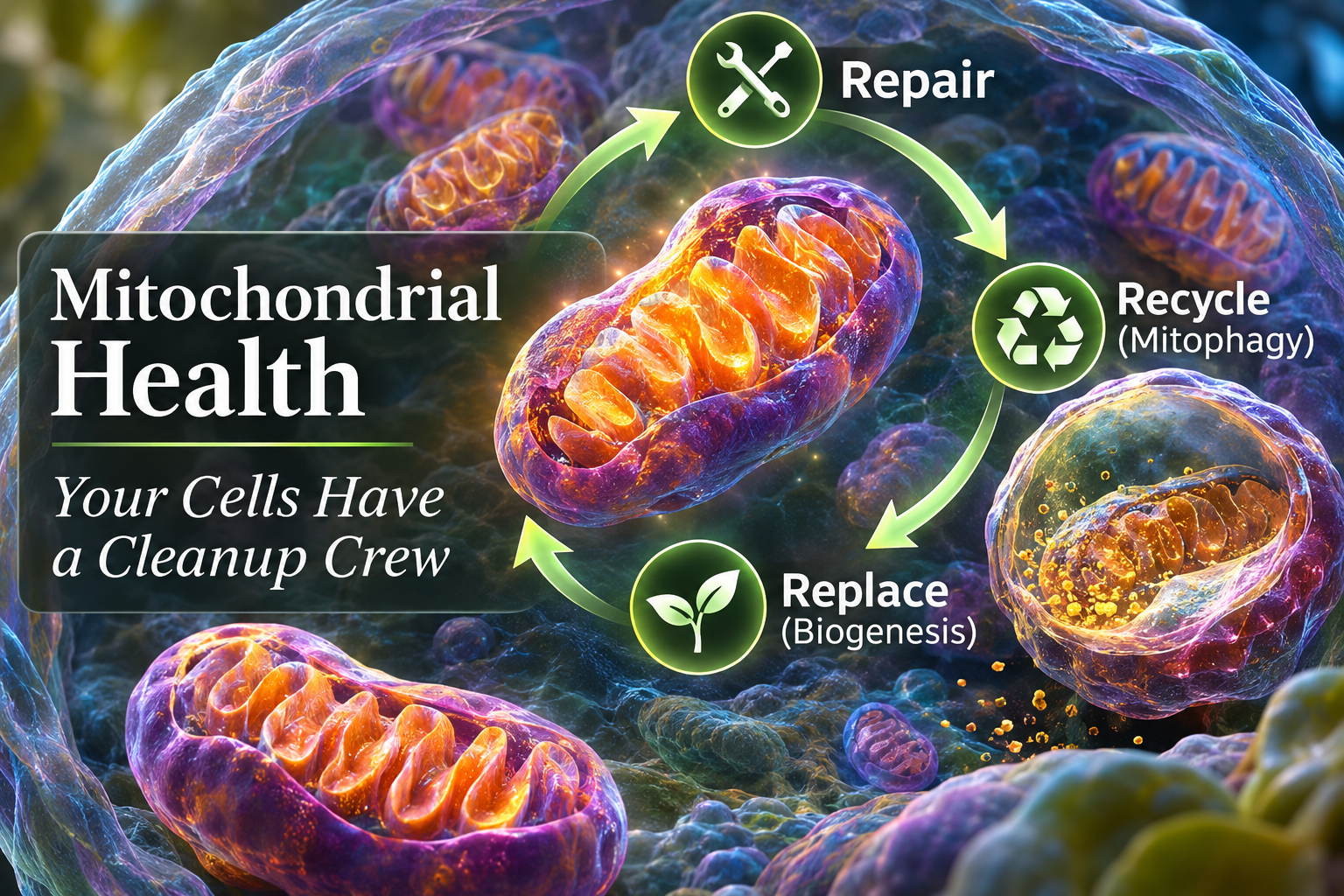
Mitochondrial Health: From Movement to Cellular Maintenance
Mitochondrial health became a fascinating subject for me as I moved from October’s focus on movement into November’s exploration of what happens inside our cells. During October, I paid attention to changes I could actually see. The way my feet stayed flat when I lowered into a squat. The moment I caught myself holding my breath. Even the way a movement that initially felt awkward became more familiar after several attempts. Those changes reminded me that the body is constantly responding to what we ask it to do.
I began treating those observations as information rather than failures. Instead of chasing someone else’s perfect movement, I wanted to understand what my own body could control and how it adapted. Eventually, that curiosity led me beneath the surface. What happens inside our cells as we move, recover, age, and respond to everyday demands? The answer involves an extraordinary system of cellular maintenance that most of us never think about.
Mitochondrial Health: More Than Making Energy
Most of us learned in school that mitochondria are the powerhouses of the cell. That description isn’t wrong, but it leaves out some fascinating biology. Mitochondria help manage calcium, communicate with other cellular structures, and influence how cells respond to stress. They also participate in signaling pathways that affect inflammation and cell survival. Their condition matters for much more than how energetic you feel on a particular afternoon.
When mitochondria become damaged, they may produce excess reactive oxygen species that affect nearby proteins, fats, and DNA. Under certain conditions, mitochondrial components can also escape into the surrounding cell and activate immune signaling. A 2025 review of mitochondria, oxidative stress, inflammation, and aging¹ explains how these processes connect mitochondrial dysfunction with inflammation and age-related changes.
Researchers increasingly describe mitochondria as part of an interconnected network rather than isolated batteries. That distinction changes the questions we should ask. Instead of searching for something that promises to boost cellular energy, we can begin examining how cells maintain their mitochondria, respond to damage, and decide which components need repair or replacement.
How Cellular Quality Control Works
Mitochondrial quality control involves several processes working together to maintain a functioning network. Fusion allows mitochondria to join and exchange contents, while fission separates portions of the network. Cells also maintain mitochondrial proteins, produce new mitochondrial components through biogenesis, and remove damaged mitochondria through mitophagy. Each process serves a different purpose, but they must remain coordinated.
A review of mitophagy in skeletal muscle² explores how mitochondrial maintenance contributes to muscle function and adaptation. These mechanisms are especially interesting because skeletal muscle must continually respond to changes in physical activity, energy demand, and recovery. Researchers are investigating how aging and exercise influence these responses, although the effects vary according to tissue, activity, and individual circumstances.
Neither fusion nor fission is automatically beneficial in every situation. Their value depends on what the cell needs and how effectively its other maintenance pathways respond. This is one reason claims about activating a single mitochondrial pathway deserve careful examination. Encouraging more removal without adequate replacement would not necessarily improve cellular function.
Mitophagy: The Remarkable Cellular Recycling Process
Mitophagy is one of the most fascinating parts of mitochondrial quality control. Through this process, cells selectively remove mitochondria that need to be broken down. The material eventually reaches a lysosome, a cellular structure containing enzymes that dismantle unwanted components. Some of the resulting materials can then become available for other cellular processes.
One well-studied pathway involves two proteins called PINK1 and Parkin. When a mitochondrion loses its normal membrane potential, PINK1 can accumulate on its outer membrane and help activate Parkin. Parkin contributes to molecular signals that identify the mitochondrion for removal. The research on PINK1 and Parkin-mediated mitochondrial quality control³ describes this process and its importance in cellular maintenance.
Cells also possess other routes for mitochondrial removal. Proteins such as BNIP3, NIX, and FUNDC1 participate in receptor-mediated mitophagy under particular conditions. Different tissues and types of cellular stress may activate different pathways. Rather than operating through one simple switch, mitophagy involves several mechanisms that researchers continue investigating.
Mitochondrial Health: Repair, Recycle, or Replace?
One of the most remarkable discoveries is that cells have options besides removing an entire mitochondrion. They can maintain damaged proteins, reorganize mitochondrial networks, and separate affected regions through fission. Sometimes they remove smaller portions of unwanted material while preserving much of the original organelle.
Researchers have identified mitochondria-derived vesicles, tiny membrane packages that transport selected materials away from mitochondria. A review of mitochondria-derived vesicles⁴ describes their involvement in mitochondrial quality control and their possible connections to inflammation and disease. I picture this process as removing a damaged board from a house rather than demolishing the entire building.
An especially interesting 2026 study in Nature Cell Biology⁵ describes mitochondria-derived vesicles carrying a protein called MFF to damaged lysosomes. Researchers found that this cargo helped support a form of lysosomal repair called budding-type fission. These experimental findings reveal an unexpected relationship between two cellular maintenance systems. Mitochondria can contribute materials that help another cellular structure maintain itself.
Why More Mitophagy Doesn’t Always Mean Better Mitochondrial Health
The idea that more cellular recycling must be better sounds appealing. Advertisements sometimes describe mitochondrial cleanup as something we should constantly increase. However, cells must balance mitochondrial removal with the production and maintenance of functioning mitochondria. Excessive removal without adequate replacement could leave cells with insufficient mitochondrial capacity.
Mitochondrial biogenesis helps maintain that balance by producing new mitochondrial components. Regulators such as PGC-1alpha coordinate aspects of this process, particularly in tissues with substantial energy demands. A review of mitophagy pathways and human disease⁶ explains why appropriate mitochondrial turnover matters and how disturbances in these processes may contribute to disease.
Exercise provides an interesting example. Research on exercise and mitophagy sensitivity in aging muscle⁷ examines how physical activity may influence mitochondrial maintenance. Responses depend on the type of activity and physiological circumstances, so walking and resistance training do not necessarily produce identical cellular changes. That reinforces something I learned during October. Consistent movement matters, but individual capacity and recovery deserve attention too.
When Mitochondrial Health and Cellular Recycling Decline
Mitochondrial dysfunction can affect much more than energy production. Damaged mitochondria may release molecules that activate inflammatory signaling, including mitochondrial DNA that enters areas of the cell where it normally should not appear. Certain immune pathways recognize these molecules as danger signals. Researchers have identified connections involving cGAS-STING and the NLRP3 inflammasome, both of which participate in inflammatory responses.
A 2025 review of mitochondrial dysfunction and aging-related diseases⁸ discusses relationships among mitochondrial damage, chronic inflammation, and cellular senescence. These processes can influence one another, potentially creating conditions that make normal cellular maintenance more difficult. Researchers are investigating whether improving mitochondrial quality control could interrupt some of these interactions.
Lysosomes also play an important role because they perform much of the final breakdown of damaged cellular material. Their function can change with age, affecting how efficiently cells process unwanted components. Research on mitochondrial therapeutics, oxidative stress, and inflammation⁹ explores these relationships, while studies of aging skeletal muscle regeneration¹⁰ examine how mitochondrial dysfunction may affect tissue repair.
Mitochondrial Health and the Aging Process
Aging affects mitochondrial function in ways researchers are still working to understand. Some cells show changes in mitochondrial shape, energy production, and the efficiency of their maintenance pathways. These changes are not identical across tissues, and chronological age alone cannot tell us how effectively someone’s mitochondria are functioning.
Research examining mitochondrial function in aging muscle¹¹ describes changes in mitochondrial dynamics, energy metabolism, and muscle performance. Another review of mitochondrial dysfunction in Parkinson’s disease and aging¹² discusses how impaired mitochondrial maintenance may contribute to cellular vulnerability in the nervous system. These findings help explain why researchers are interested in mitochondrial health across different areas of aging research.
None of this means ordinary fatigue proves mitochondrial damage or that inflammation has only one cause. It does show why scientists are studying cellular maintenance as an interconnected system rather than concentrating exclusively on energy production. The more researchers discover, the clearer it becomes that mitochondrial function depends on a delicate balance of processes.
What Mitochondrial Health Research Doesn’t Prove
Understanding an exciting biological mechanism does not automatically establish a treatment. Researchers may demonstrate that a compound affects mitophagy in cultured cells or experimental animals without showing that the same compound improves health in humans. Differences in dosage, metabolism, tissue response, and study design all matter.
That distinction becomes especially important when supplement advertisements turn preliminary research into promises about aging or cellular renewal. Scientists are still developing ways to measure mitochondrial turnover in living humans, particularly across different tissues. A change in one laboratory marker does not necessarily demonstrate improved health or longer life.
Food, movement, sleep, and stress management remain relevant to health, but they should not be presented as guaranteed ways to increase mitophagy. The science is interesting enough without stretching it beyond what researchers have demonstrated. Understanding what is established, what remains experimental, and what researchers still need to investigate helps us evaluate claims more thoughtfully.
Start Where You Are: Observe Your Own Health
If you want to apply something from this research to your own health story, begin with observation. You might notice that your energy feels steadier after several nights of consistent sleep or that a short walk changes how you feel later in the day. Perhaps a demanding workweek affects your recovery from exercise. These observations cannot measure mitophagy, but they can help you recognize patterns in your daily life.
Writing those patterns down creates a record you can revisit instead of relying entirely on memory. A journal entry about sleep, movement, food, stress, and energy may reveal changes that a bathroom scale or step counter would miss. You do not need to record everything or make the process complicated. Consistency is more useful than collecting so much information that you eventually stop tracking it.
Over time, your notes can help you ask better questions about what supports your well-being and what may need further investigation. That is the purpose behind becoming the historian of your own health. You are gathering observations that help you understand your personal patterns rather than accepting someone else’s promises about what your body supposedly needs.
Sleep, Daily Rhythms, and Mitochondrial Health
Sleep deserves attention because mitochondria respond to biological timing signals. Experimental studies suggest that circadian rhythms influence mitochondrial metabolism, biogenesis, and maintenance processes. The relationship is complex, and scientists are still examining how disrupted sleep schedules affect mitochondrial function in humans.
Research involving circadian biology cannot establish that a particular bedtime or sleep routine directly increases mitophagy. Still, observing your sleep patterns can provide useful information. Work schedules, caregiving responsibilities, pain, and everyday stress can all affect sleep quality.
Rather than pursuing perfect sleep, consider whether consistent routines make a noticeable difference in your energy and recovery. Recording those observations alongside movement and other daily habits may help you identify patterns that deserve closer attention. These personal observations are useful even though they cannot establish exactly what is happening inside your mitochondria.
What Research Reveals About Mitochondrial Health
Researchers have established that mitochondrial health depends on a coordinated network of maintenance processes. Fusion, fission, protein repair, mitophagy, vesicle transport, and biogenesis all contribute to that system. Scientists also know that aging and cellular stress can influence these pathways, although the changes differ across tissues and individuals.
Questions remain about how to measure mitophagy reliably in humans and which interventions produce meaningful, lasting health benefits. For me, that’s what makes this subject so fascinating. The more I learn about the systems working inside our cells, the more I appreciate how much the body accomplishes without our conscious involvement.
Repairing, recycling, adapting, and responding to changing demands are all part of cellular maintenance. Some processes become less efficient with age, while others change in ways researchers are still working to understand. There is no single switch that controls mitochondrial health, and no one product can replace the coordination of an entire cellular system.
What we can do is keep learning, pay attention to the patterns our bodies reveal, and make thoughtful decisions based on evidence rather than promises. Understanding what happens beneath the surface gives us better questions to ask about our own health.
Your body has a story to tell. Learn how to become the historian of your own health.
Herbally and Holistically yours,
Charlotte Lange, CNC
CPL Holistics | CPL Botanicals
References
- Xu X, et al. Mitochondria in oxidative stress, inflammation and aging: from mechanisms to therapeutic advances. Signal Transduction and Targeted Therapy. 2025. https://pubmed.ncbi.nlm.nih.gov/40500258/
- Kuznyetsova, et al. Mitophagy in skeletal muscle: Impact of ageing, exercise and disuse. Experimental Physiology. https://physoc.onlinelibrary.wiley.com/doi/10.1113/EP093041
- Narendra D, Walker JE, Youle R. Mitochondrial Quality Control Mediated by PINK1 and Parkin: Links to Parkinsonism. Cold Spring Harbor Perspectives in Biology. https://cshperspectives.cshlp.org/content/4/11/a011338.full.pdf
- Revitalizing mitochondrial quality control: targeting mitochondria-derived vesicles in Parkinson’s disease. https://www.sciencedirect.com/science/article/pii/S0006295226002686
- Luo Y, et al. Mitochondrial-derived vesicles drive budding-type fission of damaged lysosomes. Nature Cell Biology. 2026;28(8):1686-1699. https://doi.org/10.1038/s41556-026-02010-x
- The mitophagy pathway and its implications in human diseases. Signal Transduction and Targeted Therapy. https://www.nature.com/articles/s41392-023-01503-7
- Ran P, Yang L. Exercise as a Programmable Regulator of Mitophagy Sensitivity in Aging Muscle and Age-Related Disease. IUBMB Life. 2026;78(8):e70127. https://pubmed.ncbi.nlm.nih.gov/42615283/
- Zhang X, et al. Mitochondrial dysfunction in the regulation of aging and aging-related diseases. Cell Communication and Signaling. 2025;23:290. https://pubmed.ncbi.nlm.nih.gov/40537801/
- Sinha JK, et al. The Potential of Mitochondrial Therapeutics in the Treatment of Oxidative Stress and Inflammation in Aging. Molecular Neurobiology. 2025;62(6):6748-6763. https://pubmed.ncbi.nlm.nih.gov/39230868/
- Perspectives on mitochondrial dysfunction in the regeneration of aging skeletal muscle. 2025;30:94. https://pmc.ncbi.nlm.nih.gov/articles/PMC12305941/
- Burtscher J. A mito-centric view on muscle aging and function. Frontiers in Public Health. 2024;11:1330131. https://pmc.ncbi.nlm.nih.gov/articles/PMC10806989/
- Mitochondrial dysfunction in Parkinson’s disease and aging. Frontiers in Aging Neuroscience. 2026;18. https://www.frontiersin.org/journals/aging-neuroscience/articles/10.3389/fnagi.2026.1914316/full
Leave a Reply