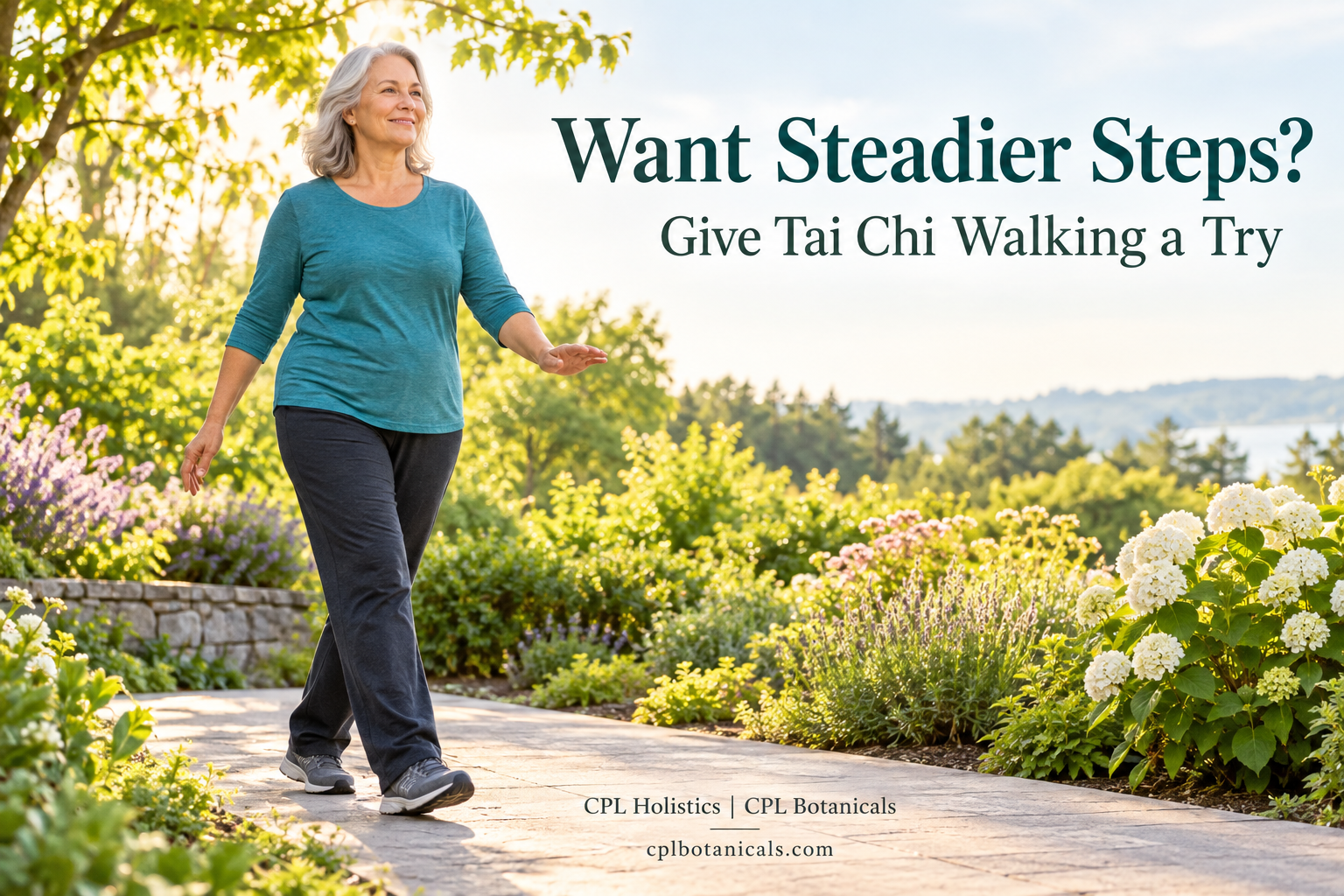
Tai Chi walking invites you to slow down and pay attention to something you probably do without thinking: taking a step. Instead of chasing distance, you practice moving your weight with control. That simple change creates an opportunity to work on balance, mobility, coordination, and the leg strength that helps you stay independent. Getting older can make those abilities feel less dependable, but movement still gives us something to work with. A thoughtful practice can begin with a few supported steps, right where you are, without turning exercise into another exhausting obligation. Picture yourself walking through the kitchen, turning toward a cabinet, or stepping around the dog.
Each movement asks your body to manage a changing position while keeping you upright. Most of us notice that process only when something feels uncertain. Perhaps a turn takes more thought, or uneven ground makes you hesitate. Slowing down can help you recognize how you move and where you need support. Tai Chi walking offers a practical way to explore that awareness, while the research on broader Tai Chi programs helps explain why controlled movement deserves a place in healthy aging.
What Tai Chi Walking Actually Means
Traditional Tai Chi combines flowing movements, changes in posture, focused attention, and breathing. Walking practice draws on those principles, emphasizing deliberate steps and controlled weight transfer. However, “Tai Chi walking” doesn’t describe one standardized routine across every class, video, or app. Some instructors teach stepping within a traditional form. Commercial programs may offer simplified movement inspired by Tai Chi. Understanding those differences helps you choose instruction that fits your needs. The Tai Chi overview¹ explains the broader practice and its health research, which provides context for walking exercises without making every routine equivalent.
During a basic stepping exercise, you give yourself time to settle over the supporting leg before moving the other foot. A small, comfortable step follows, then your weight gradually moves toward the new support. Your torso stays comfortably upright, and your knees remain soft rather than rigid. Breathing continues naturally throughout the movement. Details vary with the style and your physical needs, so good instruction matters. The purpose is to practice control within a range you can manage. A deeper stance or longer stride doesn’t automatically make the exercise better, especially when it introduces pain or instability.
What the Research Actually Shows
Research gives us encouraging reasons to consider this kind of practice, but the details matter. Most clinical trials study structured Tai Chi or therapeutic Tai Ji Quan programs over several months. Researchers haven’t established that every short routine sold as Tai Chi walking produces the same results. A well-known fall-prevention trial² enrolled 670 adults aged 70 or older who had fallen or had impaired mobility. Participants attended hour-long sessions twice weekly for 24 weeks. The therapeutic Tai Ji Quan group experienced 58 percent fewer falls than the stretching group and 31 percent fewer than the multimodal exercise group.
Those findings support a carefully designed program with repeated practice and trained instruction. They don’t establish a promise that ten minutes with any walking video will cut your fall risk by those percentages. For someone deciding where to begin, that distinction is useful. Look for a routine that teaches weight shifting and progression, rather than relying on dramatic transformation claims. Consistency also deserves more attention than intensity at the beginning. Learning to move with less hesitation can take time, and a practice needs to suit your current ability before it can become something you return to regularly.
Tai Chi Walking for Better Balance
Balance involves controlling your body as its position changes. Taking a step requires you to move away from the support of two feet and briefly rely more heavily on one leg. Turning introduces another challenge because your direction changes along with your weight. Tai Chi walking slows those transitions, giving you time to practice them deliberately. Researchers studying postural control during the first step³ found changes after intensive Tai Chi training in a small study of older adults. The study helps explain a possible training effect, although its size and design limit how broadly we can apply the findings. In everyday practice, begin with a support you can depend on, such as a fixed counter.
Let your weight travel gently from one foot toward the other while both feet remain on the floor. Notice whether your shoulders tense or your breath stops as the movement begins. A smaller shift may help you stay comfortable and controlled. Once that feels manageable, an instructor can help you progress toward stepping. Using support gives you a safer place to learn. Removing it too soon can turn useful balance practice into an unnecessary struggle to avoid falling.
Move More Comfortably Through Your Day
Mobility shows up in ordinary moments: getting across a room, changing direction, and moving comfortably enough to keep participating in life. Tai Chi practice asks the ankles, knees, and hips to work together as you shift and step. A recent study of walking mechanics⁴ examined 68 older adults classified as prefrail. Researchers compared a 12-week Tai Chi program plus health education with health education alone and reported improvements in measures of balance and walking.
Because the study involved a small, selected group, its findings offer encouragement rather than a prediction of how every reader will respond. For your own practice, comfortable movement matters more than copying someone else’s range. Shorten the step if a longer stride pulls you off balance. Keeping a higher stance may make the movement easier on your knees while you learn. Pay attention to the transition between positions, rather than concentrating only on where the foot lands. Over time, you may notice that a familiar movement feels smoother or less awkward. Those observations can help you adjust your routine, but persistent pain, locking, or giving way calls for an assessment rather than more determined practice.
Tai Chi Walking and Functional Strength
Slow movement can ask more of your legs than its quiet appearance suggests. When you gradually shift your body weight, muscles around the hips and knees help support you through the transition. Maintaining a comfortable bend in the supporting leg adds a demand that differs from simply standing still. A small Tai Chi and brisk walking trial⁵ involving 19 older women found advantages for Tai Chi in certain measures of lower-body strength, balance, and flexibility. The small sample limits confidence in the size of those benefits, but it supports further interest in this type of movement.
That doesn’t make a gentle stepping routine a replacement for every strength exercise. Building and preserving muscle usually requires a level of challenge that increases as your ability improves. Tai Chi walking can contribute to a broader routine, especially when you need an approachable starting point. Appropriate resistance exercises can work alongside it, with modifications for your joints and current health. Think about the strength needed to stand from a chair or manage a step safely. A useful plan develops those abilities directly while also giving you opportunities to practice balance and controlled movement.
Tai Chi Walking for Coordination and Attention
Coordination requires different parts of your body to cooperate at the right time. As you step, your supporting leg manages weight while the moving foot finds its next position. Your eyes and attention help guide the movement. Tai Chi practice brings those actions into conscious focus. In a walking and cognition trial⁶ involving 318 older adults with memory concerns or impairment, cognitively enhanced Tai Ji Quan improved cognition and walking while performing another task more than standard Tai Ji Quan or stretching. Participants practiced through live online classes twice weekly for 24 weeks. The enhanced program deliberately included mental challenges, so its results don’t transfer automatically to a simple stepping video.
Still, the study highlights the relationship between attention and movement. You can begin by noticing where your weight rests and whether your foot moves before you feel ready. Keep the task simple while learning. Trying to remember arm patterns and complicated sequences all at once can become frustrating. Once stepping feels comfortable, an instructor can introduce more coordination work. Progress should help you understand the movement, with enough room to correct a mistake without rushing into the next one.
Gentle Movement When Joints Feel Stiff
Stiffness can make the idea of exercise feel unappealing, particularly when your knees already complain during daily activities. Tai Chi offers movement that can often adapt to a person’s comfortable range. A knee osteoarthritis trial⁷ compared Tai Chi with physical therapy in 204 adults and found similar improvements in the main pain outcome. The Tai Chi group attended classes twice weekly for 12 weeks. Those results concern a specific condition and supervised treatment approaches.
They don’t mean every painful knee needs the same exercise, or that an unsupervised routine provides the same support as individualized care. If your joints feel sensitive, begin with smaller movements and avoid twisting on a planted foot. Let your feet reposition when you change direction, keeping the motion comfortable. A fixed support and a higher stance may make practice more manageable. Notice how you feel later that day and the following morning, rather than judging the session only while you’re moving. Sharp pain, swelling, or increasing discomfort is a reason to stop and reassess. An instructor who understands joint limitations can help with technique, while a physical therapist can assess symptoms and advise on appropriate movement.
Tai Chi Walking Without Rushing Your Body
One appealing part of a slower practice is the permission to pay attention without racing a clock. You can notice a clenched jaw, raised shoulders, or breath held during a difficult step. Easing those habits may make the session feel more comfortable. Research also connects broader Tai Chi practice with benefits beyond movement. In a sleep trial in older adults⁸ with chronic insomnia, a 12-week Tai Chi program improved objective sleep measures compared with no intervention. Conventional exercise helped too, and the study didn’t test a brief Tai Chi walking routine on its own.
During stepping practice, let breathing stay easy instead of forcing a complicated pattern. If coordinating an inhale or exhale with each step makes you tense, return to natural breathing. A quiet room can help you concentrate, but you don’t need a perfect setting or a particular mood. For me, caring for the body God has given us includes making room for patient, ordinary movement. That perspective allows a practice to feel purposeful without expecting every session to produce a breakthrough. Some days, showing up and moving with care may be the most useful thing you do.
A Gentle Way to Begin Tai Chi Walking
Choose a level surface with clear space and keep a fixed counter within reach. Wear footwear that feels secure and avoid slippery socks. Begin standing comfortably with your feet about hip-width apart, then explore a small side-to-side weight shift. Pause when you feel settled before attempting a short forward step. Gradually transfer weight only as far as you can control comfortably, then return or continue as your instructor directs. This is a starting framework, rather than a complete lesson. The Moving for Better Balance program⁹ offers structured instruction built specifically around balance and mobility training. A few minutes may be enough for your first attempt.
Finish while you still feel steady, then give yourself time to notice how your body responds. If you’ve fallen recently, use a walking aid, or have significant balance trouble, arrange supervised instruction before trying unsupported stepping. Keeping your usual support remains appropriate until a qualified professional helps you decide otherwise. Stop if you become dizzy or develop sharp pain. New chest pain or fainting needs urgent medical attention. Starting carefully protects your opportunity to continue, and good instruction can help you progress without guessing about what feels safe.
Make Tai Chi Walking Part of Healthy Aging
A routine needs a place in your actual day. Choose a time you can repeat without turning practice into another source of pressure. Perhaps you have a few quiet minutes after work or before the household gets busy. Begin with a manageable session and increase gradually as comfort and control improve. The physical activity guidance for older adults¹⁰ recommends balance work alongside aerobic activity and muscle strengthening. Adults who can do so should aim for at least 150 minutes of moderate aerobic activity weekly and strength work on at least two days, adjusting activity to their abilities.
Gentle Tai Chi walking may provide balance practice without reaching moderate aerobic intensity. Keep that in mind when deciding how it fits with regular walks or other exercise. A varied routine can support different needs, and brief practice still gives you an opportunity to move. You can journal about steadiness, comfort during turns, or how much support you used. Record what happened without treating one difficult day as proof that you’re going backward. Useful progress may appear as better control in a familiar task long before it shows up as a dramatic change in how you look.
Choosing Tai Chi Walking Instruction
Choose a teacher or instructional video that shows foot placement clearly and explains how to modify the movement. Look for enough time to follow along without hurried transitions. An instructor should welcome questions about your balance and joint limitations. For home practice, start with a beginner lesson that demonstrates weight shifting and short, controlled steps. Watch it once before following along so you can judge the pace and see whether support is available when needed. Clear instruction and a comfortable pace matter more than promises about rapid physical transformation. A class with individual feedback may help if you’re unsure about your technique.
If fall prevention is your main concern, consider a structured program with trained instruction rather than choosing by convenience alone. A follow-up study of injurious falls¹¹ found that therapeutic Tai Ji Quan reduced certain categories of fall-related injuries compared with the other trial programs. That analysis followed the same participants from the earlier fall-prevention trial, so it adds information rather than representing a separate group. The practical lesson is to match the instruction to your needs. Someone returning to movement after a long break may benefit from a different starting point than a person seeking formal help for recurrent falls.
Tai Chi Walking Begins With One Deliberate Step
Healthy aging involves keeping the ability to participate in the life you value. Walking across a room with confidence or turning comfortably toward someone can matter as much as a fitness milestone. Tai Chi walking gives you a way to practice the control behind those moments. The broader research supports structured Tai Chi for several aspects of physical function, while results depend on the program and the person practicing it. You can begin with realistic expectations and pay attention to changes that make your daily life easier. A quieter kind of progress still deserves your attention. If you’d like help observing your habits and building a health journal around your goals, work with Charlotte.
Together, we can organize what you’re noticing so you can ask clearer questions and communicate with your healthcare providers. My role as a Certified Naturopathic Coach and Herbalist centers on education and thoughtful self-observation. A journal can give your movement practice a useful record, especially when changes feel subtle from one day to the next. Your body has a story to tell. Learn how to become the historian of your own health, one observation and one deliberate step at a time.
Herbally and Holistically yours,
Charlotte Lange, CNC
CPL Holistics | CPL Botanicals
References
- National Center for Complementary and Integrative Health. Tai Chi: What You Need To Know.
https://www.nccih.nih.gov/health/tai-chi-what-you-need-to-know - Li F, et al. Effectiveness of a Therapeutic Tai Ji Quan Intervention vs a Multimodal Exercise Intervention to Prevent Falls Among Older Adults at High Risk of Falling. JAMA Internal Medicine. 2018.
https://jamanetwork.com/journals/jamainternalmedicine/fullarticle/2701631 - Hass CJ, et al. The influence of Tai Chi training on the center of pressure trajectory during gait initiation in older adults. Archives of Physical Medicine and Rehabilitation. 2004.
https://pubmed.ncbi.nlm.nih.gov/15468016/ - Effects of a 12-week Tai Chi program on postural stability and gait biomechanics in prefrail older adults: a randomized controlled study. Journal of NeuroEngineering and Rehabilitation. 2026.
https://link.springer.com/article/10.1186/s12984-026-02057-9 - Audette JF, et al. Tai Chi versus brisk walking in elderly women. Age and Ageing. 2006.
https://pubmed.ncbi.nlm.nih.gov/16624847/ - Li F, et al. Clinical Effectiveness of Cognitively Enhanced Tai Ji Quan Training on Global Cognition and Dual-Task Performance During Walking in Older Adults With Mild Cognitive Impairment or Self-Reported Memory Concerns. Annals of Internal Medicine. 2023.
https://pubmed.ncbi.nlm.nih.gov/37903365/ - Wang C, et al. Comparative Effectiveness of Tai Chi Versus Physical Therapy for Knee Osteoarthritis. Annals of Internal Medicine. 2016.
https://pmc.ncbi.nlm.nih.gov/articles/PMC4960454/ - Siu PM, et al. Effects of Tai Chi or Exercise on Sleep in Older Adults With Insomnia. JAMA Network Open. 2021.
https://jamanetwork.com/journals/jamanetworkopen/fullarticle/2776441 - Tai Ji Quan: Moving for Better Balance. Program information.
https://tjqmbb.org/wp-content/uploads/2022/01/TJQMBB-Program-Information-1.7_2022.pdf - Office of Disease Prevention and Health Promotion. 10 Things to Know About the Physical Activity Guidelines Midcourse Report.
https://odphp.health.gov/our-work/nutrition-physical-activity/physical-activity-guidelines/current-guidelines/midcourse-report/10-things-know - Li F, et al. Effectiveness of Tai Ji Quan vs Multimodal and Stretching Exercise Interventions for Reducing Injurious Falls in Older Adults at High Risk of Falling. JAMA Network Open. 2019.
https://jamanetwork.com/journals/jamanetworkopen/fullarticle/2724776
Leave a Reply