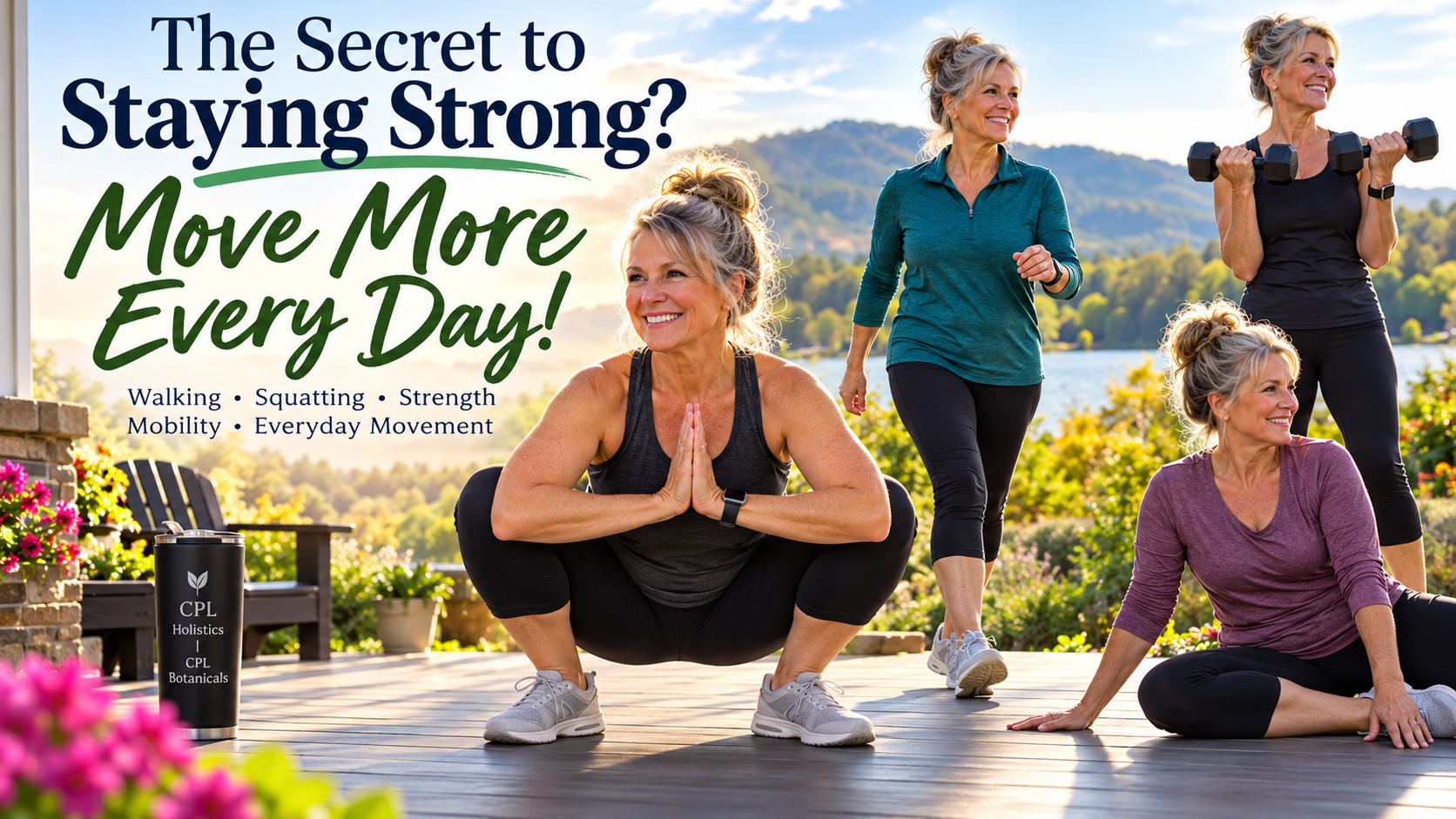
What if one of the most powerful tools for protecting your health, preserving your independence, and maintaining your mobility was something you’ve been doing your entire life? Movement as medicine is a concept supported by decades of research, yet somewhere along the way, we’ve started treating physical activity as something that belongs in a gym, requires special equipment, or demands an hour of our already busy schedules. We’ve become so accustomed to separating exercise from everyday life that we sometimes overlook the remarkable ways our bodies respond to the simple act of moving.
But your body doesn’t measure movement by gym memberships or workout schedules. It responds to what you ask it to do, how often you ask, and whether you continue challenging it as the years pass. Every time you walk across a room, rise from a chair, squat to pick something up, or reach overhead, you’re using physical abilities that help determine how independently you can live. Those ordinary movements require strength, coordination, balance, and mobility, abilities that can gradually decline when we stop using them regularly.
Throughout October, we’ve explored squatting, Tai Chi walking, strength training, and the fascinating role of fascia in mobility. Each subject revealed another piece of the same story. Your body needs regular movement to maintain the abilities you depend on every day. Now it’s time to bring those pieces together and discover how movement as medicine can become part of your life without turning your entire day into an exercise program.
Movement as Medicine: Why Your Body Needs More Than Exercise
Most people think of physical activity in terms of exercise. Walking on a treadmill, lifting weights, attending fitness classes, or following a structured workout certainly provides benefits. However, what happens during the remaining hours of the day matters, too. Someone might complete a morning workout and then spend the next ten hours sitting at a desk, driving, or watching television. Although that workout remains beneficial, the body also responds to how much time we spend inactive and how frequently we interrupt prolonged sitting.
Our bodies evolved to perform a wide variety of movements. We bend, reach, twist, carry, climb, squat, and walk. These activities require coordinated effort from our muscles, joints, nervous system, and connective tissues. When movement becomes limited or repetitive, certain physical abilities may gradually decline because they’re no longer being challenged. A person who rarely reaches overhead may notice that reaching becomes more difficult, while someone who avoids bending or squatting may gradually lose confidence in those movements.
The Physical Activity Guidelines for Americans¹ recognize the importance of both structured exercise and reducing sedentary behavior. They emphasize that adults should move more and sit less throughout the day because even modest amounts of physical activity can provide health benefits. This distinction becomes especially important as we age, when preserving everyday physical abilities can influence independence and quality of life. Movement as medicine means recognizing that physical activity doesn’t have to happen during one designated period. It can become something you practice throughout your day.
How Movement as Medicine Supports Your Health
Physical activity influences far more than muscles and joints. Regular movement affects cardiovascular function, glucose regulation, bone health, brain function, sleep, and emotional well-being. According to the Centers for Disease Control and Prevention², regular physical activity can reduce the risk of several chronic diseases while supporting cognitive function and healthier aging. Some benefits, including improvements in mood and sleep, may begin relatively quickly, while others develop through consistent activity over time.
When muscles contract during activity, they require energy. This increases glucose uptake and helps improve insulin sensitivity, making regular movement particularly valuable for metabolic health. Physical activity also challenges the cardiovascular system, helping support circulation and endurance. Even a relatively short walk after a meal can influence the body’s response to glucose, illustrating how ordinary activities can contribute to metabolic regulation without requiring an elaborate workout.
Movement also places mechanical demands on bones and muscles. Appropriate weight-bearing activity and resistance training encourage the body to maintain tissues needed for physical function, while activities involving coordination and balance challenge the nervous system to refine how the body responds to its environment. The World Health Organization’s physical activity guidelines³ recommend combining aerobic activity, muscle strengthening, and balance-focused movement, particularly for older adults. No single exercise addresses every physical need, which is why incorporating different types of movement into everyday life can provide broader benefits than relying on one activity alone.
Squatting: A Movement Worth Protecting
Earlier this month, we explored why squatting deserves a place in everyday life. Although many people associate squats with fitness programs, squatting is a fundamental movement pattern that supports ordinary activities. Think about sitting down and standing up, getting into a vehicle, gardening, or retrieving something from a low cabinet. Each activity requires some combination of hip, knee, and ankle movement, muscular strength, and balance. Squatting is a practical example of movement as medicine because it helps preserve the strength and coordination needed for everyday independence. When these abilities become limited, everyday tasks that once required little thought can become increasingly challenging.
Research examining resistance training in older adults⁴ has demonstrated improvements in muscular strength and functional performance. These findings help explain why maintaining lower-body strength is important for activities that require rising, lowering, and controlling body weight. The ability to stand up from a chair without assistance, for example, depends on coordinated muscular effort and sufficient strength through the hips and legs. Maintaining that ability can make a meaningful difference in how independently someone manages daily activities.
However, a squat doesn’t have to begin as a deep movement. Someone with limited mobility might start by standing up from a sturdy chair, gradually improving control and strength. Others may comfortably practice deeper squats or use additional resistance. The goal is to maintain the ability to move through useful ranges of motion while developing the strength to control those movements. Practicing controlled sit-to-stands from a sturdy chair is one accessible way to begin, with support available when necessary.
Tai Chi Walking: Movement as Medicine for Balance
Walking is one of the most accessible forms of physical activity, but changing how we walk can introduce different challenges for balance, coordination, and body awareness. Tai Chi walking emphasizes deliberate weight shifting, controlled stepping, upright posture, and attention to movement. Instead of simply moving from one destination to another, the practice encourages awareness of how your feet contact the ground, how your body transfers weight, and how your muscles work together to maintain stability.
Research on Tai Chi and fall prevention⁵ suggests that Tai Chi can improve balance and reduce falls among older adults, although results depend on the population and program studied. These benefits are especially relevant because balance relies on coordination between the visual system, vestibular system, sensory feedback, and muscles. As we age, changes in these systems can affect stability, particularly when walking on uneven surfaces, turning quickly, or recovering from an unexpected shift in body position.
Tai Chi walking also offers a useful reminder that movement doesn’t always have to be fast or strenuous. Slower movements can demand considerable attention and muscular control because the body must maintain stability throughout each deliberate weight shift. Spending several minutes practicing slow, controlled steps near a sturdy support can provide an opportunity to challenge balance while developing greater awareness of how the body moves. For someone accustomed to rushing through daily activities, slowing down can reveal just how much coordination is involved in something as familiar as walking.
Strength Training: Building the Muscles That Keep You Independent
Muscle loss is one of the most important physical changes associated with aging. Beginning in adulthood, muscle mass and strength can gradually decline, with the rate often increasing later in life. This process, commonly associated with sarcopenia, can affect much more than appearance. Reduced muscular strength may make climbing stairs, carrying groceries, rising from a chair, and recovering from a loss of balance increasingly difficult. Over time, these limitations can influence whether someone feels confident performing activities independently.
Fortunately, muscles retain the ability to respond to resistance training throughout life. Research published in the Journal of Strength and Conditioning Research⁶ found that progressive resistance training can improve muscular strength and physical performance in older adults. The benefits extend to people who haven’t previously participated in formal strength-training programs, demonstrating that beginning later in life can still produce meaningful improvements. Although individual results vary, appropriate resistance training provides a way to challenge the muscular system and encourage continued adaptation.
Resistance training can include weights, resistance bands, machines, or exercises using your own body weight. What matters is providing an appropriate challenge and gradually increasing that challenge as your abilities improve. This is where movement as medicine becomes especially valuable, helping maintain the muscular strength needed for everyday activities. The National Institute on Aging⁷ encourages older adults to include strength-building activities as part of a balanced physical activity program. Simple exercises such as wall push-ups, chair squats, and resistance-band rows can help develop strength for ordinary activities. Rather than focusing exclusively on how much weight someone can lift, consider how maintaining muscular strength supports the freedom to continue doing the things that matter in everyday life.
Fascia and Mobility: Why Variety Matters
Last week’s discussion explored fascia, the connective tissue network that surrounds and connects muscles, organs, nerves, and other structures throughout the body. Fascia plays an important role in transmitting mechanical forces and allowing tissues to interact during movement. Its properties are influenced by multiple factors, including tissue composition, loading, and physical activity. Although fascia has received increasing attention in discussions about flexibility and stiffness, it functions as part of a larger movement system rather than acting independently of muscles, joints, and nerves.
Scientific reviews examining fascia and force transmission⁸ describe how connective tissues contribute to the mechanical relationships between muscles and surrounding structures. However, stiffness and restricted mobility cannot automatically be attributed to fascia alone. Joint structure, muscle function, nervous system responses, and medical conditions may also contribute. This distinction matters because addressing mobility often requires considering several influences rather than assuming that one tissue is responsible for every movement limitation.
This is one reason varied movement is valuable. Incorporating varied activities reinforces the principles of movement as medicine by challenging the body through different movement patterns. Walking repeatedly challenges certain movement patterns, while reaching, rotating, squatting, and bending introduce different demands. Mobility exercises help you practice controlling movement through available ranges of motion, while gentle stretching may support flexibility when performed consistently. Including shoulder circles, controlled hip circles, ankle movements, and comfortable trunk rotations throughout the day creates opportunities to explore movements that ordinary routines may overlook. The objective isn’t to force your body into extreme positions. It’s to preserve and gradually improve comfortable, useful movement.
Everyday Movement as Medicine: Small Actions Add Up
One of the biggest misconceptions about physical activity is that a movement session must be long to matter. Current guidelines recognize that physical activity accumulated in shorter periods can contribute to health benefits. The U.S. Department of Health and Human Services⁹ removed the previous requirement that aerobic activity occur in sessions lasting at least ten minutes. This reflects research showing that shorter bouts can contribute to total physical activity, making it easier to incorporate movement into schedules that don’t allow for lengthy exercise sessions.
Consider how many opportunities exist during an ordinary day. Walking while talking on the telephone, standing up between work tasks, carrying groceries, gardening, and taking the stairs all require physical effort. Someone working at a desk might stand periodically, walk around the office, or perform a few controlled squats before returning to work. At home, ordinary tasks such as putting away laundry, preparing meals, and tending a garden can provide additional opportunities to bend, reach, carry, and change positions.
However, everyday activity doesn’t always provide enough intensity or resistance to fully replace structured exercise. Light household movement may interrupt sedentary time without meeting the demands needed for substantial cardiovascular or muscular improvements. The most useful approach combines ordinary movement with intentional activities that challenge strength, endurance, and balance. Instead of asking only whether you’ve completed your workout, begin asking how often you’ve given your body an opportunity to move. Those opportunities can accumulate throughout the day without requiring you to rearrange your entire schedule.
Why Sitting Less Matters for Healthy Aging
Modern life makes prolonged sitting remarkably easy. Many of us spend hours working at computers, driving, watching television, or using electronic devices. Even people who consider themselves physically active may spend much of their remaining day seated. Although sitting is a normal and necessary part of life, extended periods of inactivity can reduce the opportunities our muscles and joints have to perform varied movements.
Prolonged sedentary behavior has been associated with poorer cardiovascular and metabolic outcomes. The WHO’s sedentary behavior recommendations¹⁰ encourage adults to limit sedentary time and replace it with physical activity whenever possible. Research examining sedentary behavior and mortality¹¹ has also found associations between greater sedentary time and higher health risks, although the relationship is influenced by total physical activity and other factors. These findings reinforce the importance of considering both intentional exercise and the broader patterns of activity throughout the day.
This doesn’t mean sitting is inherently harmful or that every moment must be filled with activity. Rest and recovery are necessary parts of physical health. Instead, consider how easily sitting can become the default position for most of the day. Practicing movement as medicine throughout the workday can be as simple as interrupting prolonged sitting with walking, standing, or gentle mobility exercises. A simple strategy is to connect movement with activities you already perform. Stand up after finishing a work task, walk while waiting for coffee, or perform a few controlled movements before sitting down to watch television. By attaching movement to familiar routines, it becomes easier to maintain consistency without depending entirely on motivation.
Building a Daily Movement as Medicine Routine
Creating a sustainable movement routine begins with understanding what your body can currently do. Someone who has been sedentary for years may need a different starting point than someone who already walks regularly and performs strength exercises. Physical limitations, previous injuries, chronic conditions, and individual fitness levels can influence which activities are appropriate. The objective is to create a routine that challenges your body without demanding more than it can safely manage.
The CDC’s physical activity recommendations¹² encourage adults to gradually increase activity according to their abilities. For most adults, the general target is at least 150 minutes of moderate-intensity aerobic activity weekly, along with muscle-strengthening activities on two or more days. Balance training becomes particularly important as we grow older. The WHO¹³ recommends varied activities emphasizing functional balance and strength on at least three days per week for adults aged 65 and older.
Rather than trying to accomplish everything at once, distribute different movements throughout your day. This allows you to practice several physical abilities while making movement a more natural part of your routine.
Morning: Wake Up Your Joints
Begin with several minutes of gentle mobility work. Shoulder circles, ankle movements, hip circles, and comfortable spinal rotations can help you assess how your body feels and prepare for the day’s activities. If mornings bring stiffness, begin slowly and gradually increase your movement as tolerated. The purpose isn’t to complete an intense workout before breakfast, but to introduce comfortable movement after a night of relative inactivity.
During the Day: Interrupt Sitting
Stand up periodically, take short walks, and change positions throughout your workday. Practice a few controlled chair squats or walk around your home or workplace when opportunities arise. If you spend much of the day at a computer, use natural breaks between tasks as reminders to move. These small activities provide opportunities to interrupt long periods of sitting while practicing movements that support everyday function.
Afternoon: Build Strength and Balance
Include a brief strength session on appropriate days. Chair squats, resistance-band exercises, and controlled step-ups can challenge muscles needed for everyday activities. Practice balance exercises near sturdy support, particularly if you feel uncertain about your stability. Even standing on one foot for a few seconds can provide a challenge when performed safely. Strength and balance exercises can be adjusted to match your abilities and gradually progressed as your confidence and control improve.
Evening: Keep Moving Comfortably
Finish the day with a gentle walk, Tai Chi walking, or comfortable mobility exercises. Choose movements that feel appropriate for your energy level and physical condition. Some evenings may be suitable for a longer walk, while others may call for a few minutes of gentle stretching or controlled joint movements. This routine is an example rather than a rigid prescription. Your daily activities, recovery needs, and physical limitations should guide how you arrange movement.
Movement as Medicine Doesn’t Require Perfection
Perhaps the greatest obstacle to maintaining physical activity is believing that every session must be completed perfectly. A missed workout can become an excuse to abandon an entire routine, while limited time may convince someone that five minutes of movement isn’t worthwhile. Physical limitations can create the impression that meaningful progress is impossible, especially when comparing current abilities with what the body could accomplish years earlier.
Yet the WHO physical activity guidelines¹⁴ emphasize that doing some activity is better than doing none. People who cannot meet standard recommendations can still benefit from being active within their abilities. Progress may involve walking a little farther, performing another controlled squat, improving balance, or moving through a slightly greater comfortable range of motion. These changes may appear small when viewed individually, but maintaining physical abilities can influence how confidently and independently we perform ordinary tasks.
Consistency also allows you to observe how your body responds. Perhaps your ankles move more comfortably after several weeks of regular mobility exercises, or you notice that standing from a chair requires less effort. Some days will feel easier than others, and progress may not follow a predictable pattern. The important question isn’t whether your movement looks like someone else’s. It’s whether you’re consistently giving your body appropriate opportunities to maintain and improve its abilities.
Your Body’s Future Is Influenced by What You Do Today
Throughout October, we’ve examined movement from several perspectives. Squatting reminds us why functional strength matters. Tai Chi walking demonstrates the importance of balance and coordination. Resistance training helps preserve muscular strength, while mobility work encourages us to maintain useful movement throughout our joints and surrounding tissues. These activities complement one another because human movement depends on multiple systems working together, and each contributes something valuable to our ability to function.
The National Institute on Aging’s exercise guidance¹⁵ emphasizes combining endurance, strength, balance, and flexibility activities to support physical function as we grow older. You don’t need to master every exercise or follow an elaborate program to begin. Ultimately, movement as medicine is about preserving the physical abilities that allow you to remain active, capable, and independent as you grow older. Start with movements appropriate for your abilities, repeat them consistently, and gradually introduce new challenges. Whether you’re walking around your neighborhood, practicing a few squats while waiting for coffee, or taking time to improve your balance, you’re giving your body opportunities to maintain abilities that matter.
Your body adapts to the demands you place upon it. Give it opportunities to remain capable, and remember that the movements you practice today can help support the independence you want to maintain tomorrow.
Work With Charlotte: Learn to Become the Historian of Your Own Health
Your body has a story to tell, and the way you move is part of that story. Changes in strength, flexibility, balance, and everyday function can offer valuable clues about how your body is responding to aging, activity, recovery, and other influences. Paying attention to those patterns can help you better understand your physical abilities and recognize when something begins to change.
At CPL Holistics, I help people take a closer look at their health patterns, understand the connections between different aspects of well-being, and develop practical approaches that support their individual goals. If you’re ready to become more involved in understanding your health, visit the Work With Charlotte page at CPL Botanicals to learn about my holistic coaching services.
Movement is one chapter in your health story. Pay attention to what your body is telling you, and give it reasons to keep moving.
Your body has a story to tell. Learn how to become the historian of your own health.
Herbally and Holistically yours,
Charlotte Lange, CNC
CPL Holistics | CPL Botanicals
References
- U.S. Department of Health and Human Services. Physical Activity Guidelines for Americans, 2nd Edition. 2018.
https://health.gov/sites/default/files/2019-09/Physical_Activity_Guidelines_2nd_edition.pdf - Centers for Disease Control and Prevention. Benefits of Physical Activity.
https://www.cdc.gov/physical-activity-basics/benefits/index.html - World Health Organization. WHO Guidelines on Physical Activity and Sedentary Behaviour. 2020.
https://www.who.int/publications/i/item/9789240015128 - Fragala MS, et al. Resistance Training for Older Adults: Position Statement From the National Strength and Conditioning Association. Journal of Strength and Conditioning Research. 2019.
https://doi.org/10.1519/JSC.0000000000003230 - Sherrington C, et al. Exercise for Preventing Falls in Older People Living in the Community. Cochrane Database of Systematic Reviews. 2019.
https://doi.org/10.1002/14651858.CD012424.pub2 - Fragala MS, et al. Resistance Training for Older Adults. Journal of Strength and Conditioning Research. 2019.
https://doi.org/10.1519/JSC.0000000000003230 - National Institute on Aging. Exercise and Physical Activity.
https://www.nia.nih.gov/health/exercise-and-physical-activity - Wilke J, et al. What Is Evidence-Based About Myofascial Chains: A Systematic Review. Archives of Physical Medicine and Rehabilitation. 2016.
https://doi.org/10.1016/j.apmr.2015.07.023 - U.S. Department of Health and Human Services. Physical Activity Guidelines for Americans, 2nd Edition. 2018.
https://health.gov/sites/default/files/2019-09/Physical_Activity_Guidelines_2nd_edition.pdf - World Health Organization. WHO Guidelines on Physical Activity and Sedentary Behaviour. 2020.
https://www.who.int/publications/i/item/9789240015128 - Ekelund U, et al. Dose-Response Associations Between Accelerometry Measured Physical Activity and Sedentary Time and All Cause Mortality. BMJ. 2019.
https://doi.org/10.1136/bmj.l4570 - Centers for Disease Control and Prevention. What You Can Do to Meet Physical Activity Recommendations.
https://www.cdc.gov/physical-activity-basics/guidelines/index.html - World Health Organization. WHO Guidelines on Physical Activity and Sedentary Behaviour. 2020.
https://www.who.int/publications/i/item/9789240015128 - World Health Organization. WHO Guidelines on Physical Activity and Sedentary Behaviour. 2020.
https://www.who.int/publications/i/item/9789240015128 - National Institute on Aging. Exercise and Physical Activity.
https://www.nia.nih.gov/health/exercise-and-physical-activity
Leave a Reply