Health misinformation rarely looks ridiculous when you first see it. It usually looks convincing. A headline says researchers have made a shocking discovery, a social media post quotes a doctor, or someone shares a study that supposedly proves what we’ve all been told about a food, medication, herb, supplement, or disease is wrong. Some of these claims begin with legitimate research and become distorted as they’re repeated. Others leave out important details that would completely change how you interpret them. MedlinePlus recommends evaluating who provides health information, why it was created, where the information came from, and whether it is current¹ (MedlinePlus). Learning how to recognize health misinformation doesn’t mean becoming suspicious of everything. It means knowing what questions to ask before allowing a headline to influence what you believe about your health.
This is especially important when you’re living in the health gray area. You may know something has changed in your body even though laboratory results, appointments, or standard testing haven’t given you a clear explanation. When you’re searching for answers, someone confidently announcing “the real cause doctors are missing” can be incredibly persuasive. The same thing can happen when a conventional source dismisses something you’ve personally experienced simply because the answer isn’t obvious yet. The National Library of Medicine explains that trustworthy health information should identify its sources, its purpose, who is behind it, and whether experts review the information¹⁶ (MedlinePlus). Discernment has to work in both directions.
Health Misinformation Trap #1: “A Study Proves It”
Few phrases carry more authority than “a study found.” The problem is that those words can describe very different kinds of research. A laboratory experiment using isolated cells is a study. So is an animal study, an observational study, or a randomized controlled human trial. They don’t answer the same questions. The NIH explains that different clinical study designs have different strengths and limitations². It describes well-designed randomized controlled trials as the gold standard for determining whether an intervention causes an outcome. Before allowing a study to change your mind, find out what kind of study it actually was.
An animal or laboratory study can be extremely useful. It may reveal a biological mechanism or identify something worth investigating further. It can’t automatically tell us what will happen inside a human body under real-life conditions. Observational studies are also valuable. Researchers can follow people in normal settings and identify patterns worth investigating. The National Institute on Aging explains how observational studies follow people while researchers collect information over time³. That information can generate important questions. Finding a pattern, however, isn’t the same as proving what caused it.
Human clinical trials can provide stronger evidence. This is particularly true when participants are randomly assigned to treatment and comparison groups. Even the words “randomized controlled trial” don’t end the investigation. How many people participated? Who were they? How long did the trial last? What dose was used? What outcome was measured? How many people dropped out? Was the difference actually meaningful? NIH describes clinical trials as studies examining ways to prevent, detect, or treat disease in human participants¹⁷. Study design matters, but the details inside that design matter too.
Health Misinformation Trap #2: One Study Becomes Settled Science
A single study can make an exciting headline precisely because it is new. New doesn’t necessarily mean established. Scientific understanding develops as researchers reproduce findings, challenge them, identify weaknesses, study different populations, and compare new results with what has already been discovered. That’s why one study that contradicts twenty previous studies deserves investigation, but it doesn’t automatically erase everything that came before it. Cochrane explains that systematic reviews examine research addressing a particular question in a standardized way so the larger body of evidence can be evaluated⁴ (Cochrane).
Systematic reviews are particularly useful because researchers establish methods for finding and assessing relevant evidence rather than simply choosing a handful of studies that support the conclusion they already prefer. They aren’t infallible, because the quality of a review still depends partly on the quality of the research available to review. Cochrane states that systematic reviews are designed to minimize bias through prespecified questions and methods and by basing conclusions on reliable research⁵ (Cochrane). When a viral claim rests on one exciting paper while several larger or better-designed studies point elsewhere, that context matters.
You’ll also hear the term meta-analysis. A meta-analysis can statistically combine results from multiple studies when doing so is appropriate, allowing researchers to estimate an effect using more information than any individual study provides. That doesn’t mean every meta-analysis deserves unquestioned acceptance. Differences among study populations, methods, interventions, and bias can affect the result. Cochrane defines meta-analysis as the statistical combination of results from two or more separate studies and cautions that poorly considered differences among studies can produce misleading conclusions⁶ (Cochrane). Bigger numbers don’t repair bad underlying research.
Health Misinformation Trap #3: Association Quietly Turns Into Cause
This is one of the most common ways legitimate research becomes misleading health information. Imagine researchers observe that people who regularly consume a particular food have lower rates of a certain condition. That finding may be important, but it doesn’t automatically prove the food prevented the condition. Those same people may exercise more, smoke less, eat differently overall, have different incomes, receive different medical care, or differ in dozens of other ways. NIH distinguishes observational research from randomized trials when discussing whether research can establish cause and effect² (National Institutes of Health (NIH)).
Pay close attention to the words used in the original research. “Associated with,” “linked with,” and “correlated with” describe a relationship between variables. They don’t necessarily mean one variable caused the other. Somewhere between the scientific paper and your Facebook feed, however, “associated with a lower incidence” can become “prevents,” while “associated with increased risk” becomes “causes.”. Sometimes the research itself is sound and the exaggeration happens later.
The same mistake can happen in natural health. Researchers may discover that a plant contains a constituent with an interesting effect in laboratory testing. That doesn’t prove drinking a cup of tea made from that plant will create the same effect in a person, because preparation, concentration, absorption, metabolism, and dose all enter the picture. NCCIH advises consumers to examine what scientific evidence actually says about complementary health approaches rather than assuming preliminary findings prove effectiveness¹⁰ (NCCIH). Interesting evidence should make us curious. It shouldn’t make us careless with language.
Health Misinformation Trap #4: The Headline Is Stronger Than the Research
Headlines have one job that scientific papers don’t have. They have to make you click. “Researchers observe a modest association that requires additional study” isn’t likely to travel very far on social media. “Scientists discover food that destroys cancer” will. Before accepting a dramatic claim, trace it back to its original source whenever possible. PubMed is a free National Library of Medicine resource containing more than 40 million citations and abstracts from biomedical and life-sciences literature⁷ (PubMed). You don’t have to understand every statistical calculation to compare what researchers wrote with what the headline claims they wrote.
Start with the abstract and identify some basics. Were researchers studying humans, animals, or cells? How many participants were included? How long were they followed? What did researchers actually measure? Did they measure the disease itself, a symptom, a laboratory marker, or something used as a substitute for the outcome that really matters? MedlinePlus recommends checking where health information came from, whether experts reviewed it, whether dramatic claims sound believable, and whether the information is current¹⁶ (MedlinePlus). Those few questions can eliminate a surprising amount of questionable information.
Then look for the study’s limitations. Responsible researchers routinely discuss weaknesses, unanswered questions, and reasons their results may not apply to everyone. Unfortunately, those qualifications often disappear by the time research becomes a news story or marketing claim. NCCIH provides guidance specifically on how to make sense of a scientific journal article instead of relying only on someone else’s description of the research¹⁰ (NCCIH). Sometimes the most important sentence in a paper is the one acknowledging what the researchers still don’t know.
Health Misinformation Trap #5: “Natural” Automatically Means Safe
I’m an herbalist, so this distinction matters to me. Respecting plant medicine doesn’t mean pretending every natural substance is harmless. Herbs contain biologically active compounds. That’s part of why we use them. But herbs can also cause unwanted effects or interact with medications. Some simply aren’t appropriate for every person. NCCIH cautions that natural doesn’t necessarily mean safer or better¹¹. Acknowledging that doesn’t diminish the value of herbal medicine.
Traditional herbal use also deserves accurate language. Many plants have hundreds or thousands of years of recorded use. That history can tell us how people prepared a plant and what they used it for. Modern research asks different questions. It may examine constituents, mechanisms, dosing, effectiveness, and safety. NCCIH provides research and evidence about dietary supplements, herbs, and botanicals¹³. Traditional use and clinical research both provide information, but they aren’t the same type of evidence.
The opposite extreme isn’t helpful either. A lack of large clinical trials doesn’t erase generations of recorded traditional knowledge. Funding can also affect what gets studied. Expensive trials may be less attractive when a plant can’t easily be patented. But traditional use alone doesn’t prove every modern claim made for an herb. NCCIH recommends considering evidence, product quality, safety, and possible interactions¹². Respecting herbal medicine means being accurate about what we know and what remains uncertain.
Herb-drug interactions are another reason accuracy matters. St. John’s wort is a well-known example. It can interact with numerous medications by affecting drug metabolism. Other botanicals may affect bleeding, sedation, blood pressure, blood sugar, or medication levels. The effects depend on the herb and medication involved. NCCIH identifies herb-drug interactions, toxicity, and contamination as potential safety concerns¹⁴. “Natural” and “powerful” can absolutely exist in the same sentence.
Health Misinformation Trap #6: The Product Being Sold Isn’t What Was Studied
This one is easy to miss. An advertisement may tell you that “clinical research proves” an ingredient works, but the study may have tested a specific extract, standardized concentration, dose, preparation, or combination that isn’t equivalent to the product being advertised. Botanical products can differ according to plant species, plant part, growing conditions, extraction method, concentration, storage, and manufacturing. NCCIH’s dietary and herbal supplement resources emphasize evaluating the evidence for specific supplements and ingredients rather than treating every product with a similar name as interchangeable¹³ (NCCIH). Seeing the name of an herb in a scientific paper doesn’t automatically validate every bottle containing that herb.
The same issue appears with probiotics. “Probiotics are clinically proven” is so broad that it tells you almost nothing. Different products contain different organisms, strains, combinations, and amounts. Evidence for one organism and one condition doesn’t automatically establish effectiveness for every probiotic product or every digestive complaint. NCCIH reports that probiotic effects can vary and that important questions remain about which probiotics are helpful, for whom, and under what circumstances¹⁵ (NCCIH). The more specific a claim becomes, the more specifically the evidence needs to match it.
Advertising deserves the same scrutiny whether the product comes from a pharmaceutical company, supplement company, wellness influencer, herbal company, or anyone else trying to sell something. Having a financial interest doesn’t automatically make someone dishonest, but it does give you another piece of information to consider. The Federal Trade Commission states that companies making objective health-related claims need appropriate scientific substantiation for those claims⁸ (Federal Trade Commission). “Clinically studied ingredients” can sound impressive while carefully avoiding the much more important question of whether the finished product itself was studied.
Health Misinformation Trap #7: Impressive Numbers Without Context
Percentages can make a health story sound enormous. Imagine an outcome occurs in 2 people out of 1,000 in one group and 1 person out of 1,000 in another. That difference could be described as a 50 percent reduction in relative risk. “Cuts your risk by 50 percent” sounds dramatic. The absolute difference is one person out of 1,000. Medical literature distinguishes relative risk from absolute risk because the two measurements communicate different information about the size of an effect¹⁸ (PubMed Central (PMC)).
Neither number is inherently dishonest. The problem occurs when only the most impressive number is presented. Whenever a headline says something raises your risk by 40 percent or lowers your risk by 60 percent, look for the baseline numbers. How many people actually experienced the outcome in each group? Was the event common or extremely rare? Research on communicating medical risk recommends considering absolute as well as relative measures so readers can understand the practical size of a difference¹⁹ (PubMed Central (PMC)). Context turns a frightening percentage into information you can actually interpret.
Statistical significance deserves context too. A result can meet a statistical threshold without creating a change large enough to matter much in everyday life, while other research may identify an effect that is clinically important even though uncertainty remains about its precise size. This is another reason reading only the headline can create trouble. NIH’s guidance on understanding clinical studies encourages readers to look beyond simple declarations of success and consider study design, population, outcomes, and limitations² (National Institutes of Health (NIH)). Numbers aren’t the enemy. Numbers without context are.
Testimonials Are Evidence of an Experience, Not Proof of a Treatment
Personal stories matter, especially when we’re trying to understand our own bodies. If you take something and your pain improves, your digestion changes, or you sleep better, that experience belongs in your health history. What one experience can’t establish on its own is whether the intervention definitely caused the improvement, whether something else changed at the same time, or whether another person should expect the same result. FTC health-product guidance explains that testimonials and endorsements don’t replace the scientific substantiation required for objective health claims⁸ (Federal Trade Commission). A testimony tells us what someone experienced. It doesn’t establish a universal outcome.
That distinction also protects valuable individual observations from being dismissed. Personal experience can be the beginning of a question. Repeated observations may eventually inspire formal research. Your own symptom journal may reveal a pattern important enough to investigate with your provider. MedlinePlus advises checking where a social-media health claim originated and why it was created before deciding whether it is trustworthy enough to share¹ (MedlinePlus). We don’t have to choose between listening to people and requiring stronger evidence before making broad medical claims.
Watch for the Language of Health Fraud
Some claims deserve immediate skepticism because they follow patterns regulators see repeatedly. Products may promise to cure many unrelated diseases, claim to work immediately for almost everyone, insist they replace established treatments, or suggest that a secret cure is being deliberately hidden from the public. The FDA maintains resources on products promoted with deceptive disease-treatment claims and other health-fraud violations. The FDA warns consumers about health-fraud products marketed with unsupported claims to prevent, treat, or cure diseases and conditions⁹ (U.S. Food and Drug Administration).
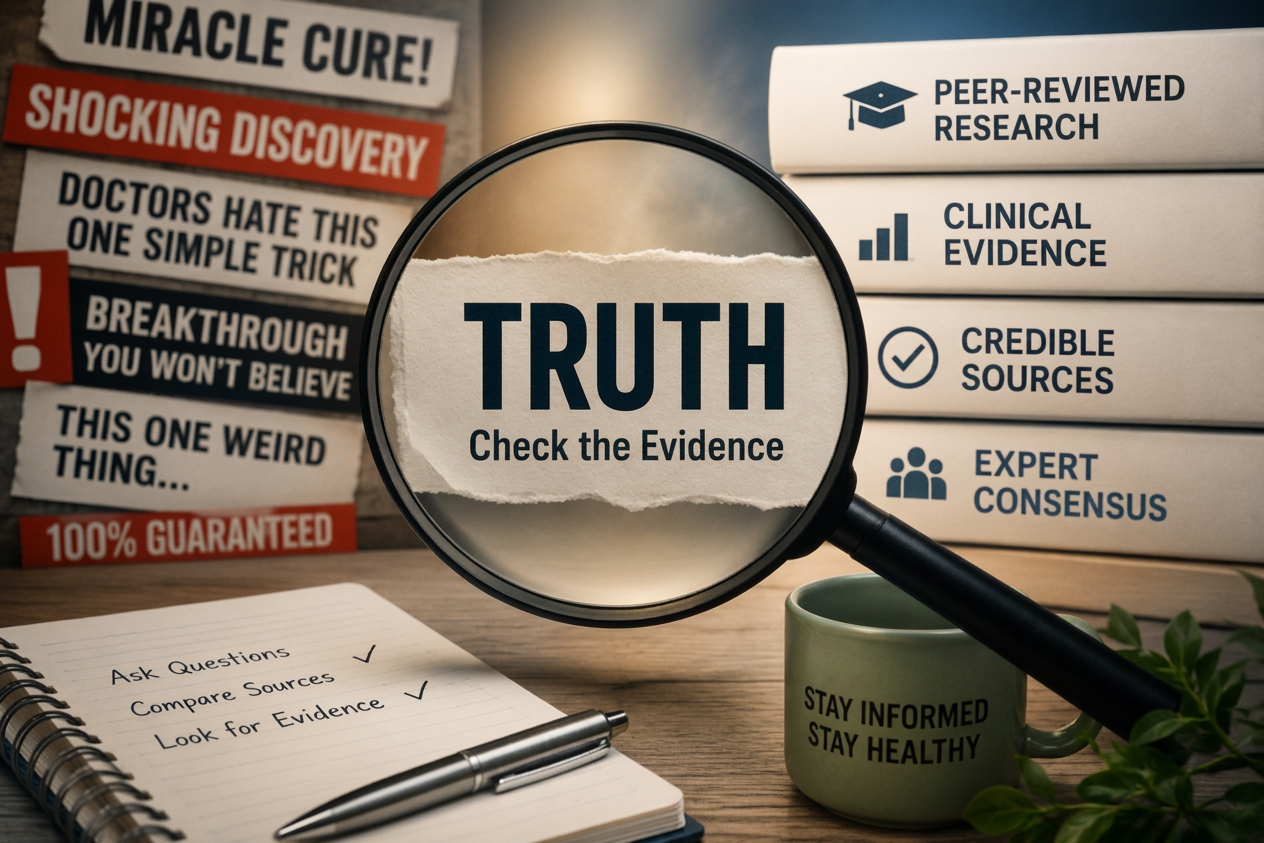
Fear and urgency are powerful sales tools. “Buy before they ban it,” “doctors don’t want you to know,” “this cures everything,” and “one weird trick” should make you investigate more carefully, not purchase more quickly. The FDA has specifically identified miracle-cure language and products claiming to treat a wide range of unrelated conditions as warning signs associated with fraudulent health products. The FDA’s consumer guidance describes common tip-offs that can help identify health-fraud scams²⁰ (U.S. Food and Drug Administration). Strong evidence doesn’t need conspiracy language to make it stronger.
How to Check a Health Claim Before You Believe It
When you encounter a claim that makes you frightened, excited, angry, or ready to immediately change something about your health, give yourself enough time to trace it backward. Find the original source if possible. Determine who made the claim, what they’re actually claiming, what type of evidence they provide, and whether someone is selling something connected to that conclusion. The National Library of Medicine’s health-information checklist recommends examining the provider, funding, source quality, expert review, advertising, and date of the information¹⁶ (MedlinePlus). Those questions work whether the claim came from Facebook, TikTok, a supplement website, a television report, a news article, or a professional-looking health site.
Then compare the strength of the language with the strength of the evidence. Does the research say “may,” while the post says “will”? Does the study identify an association while the headline announces a cause? Was something tested in animals but advertised as a proven treatment for people? Was one study presented as though no other research existed? NCCIH’s Know the Science program specifically teaches consumers to examine scientific studies, health news, complementary therapies, and supplement claims more carefully¹⁰ (NCCIH). Small wording changes can reveal very large differences in what the evidence actually supports.
Finally, be willing to leave the answer open. “We don’t know yet” isn’t a failure. It’s sometimes the most accurate conclusion available. New research can strengthen a theory, weaken it, or show that an intervention helps one population but not another. Cochrane’s approach to evidence assessment recognizes that conclusions depend on the quality, consistency, and totality of available research rather than certainty created by a single result⁴ (Cochrane). Good health information should be able to tolerate uncertainty without replacing it with hype.
Discernment Matters in the Health Gray Area
People living in the health gray area may be particularly vulnerable to confident answers because uncertainty is exhausting. When you’ve spent months or years trying to understand why you don’t feel well, an explanation that seems to connect every symptom can be difficult to resist. Sometimes a person really does discover a pattern that deserves further investigation. But the strength of the feeling that something fits doesn’t determine whether the explanation is correct. Reliable health-information guidance encourages checking the source and evidence before allowing an online claim to influence important health decisions¹ (MedlinePlus).
This is one reason I believe becoming the historian of your own health matters. Track what happened, when it happened, what changed beforehand, what made it better or worse, what medications and supplements you were using, what your laboratory results showed, and what else was happening in your life at the time. Your history doesn’t replace research or medical evaluation, but it gives you better information with which to ask questions. NIH describes clinical research as a process of gathering evidence to better understand health and disease rather than relying on assumption alone¹⁷ (National Institutes of Health (NIH)). Your own history deserves that same respect for details.
Discernment also fits naturally with faith. Proverbs 18:17 tells us that the first person to present a case may sound right until someone else examines it. That’s a useful principle far beyond a courtroom. The first health explanation we encounter may sound convincing, but it still deserves examination. Learning to evaluate health information by checking its source, evidence, purpose, and accuracy¹⁶ (MedlinePlus) allows us to remain curious without accepting every claim and skeptical without automatically rejecting everything unfamiliar.
Your Body Has a Story to Tell
Health research can teach us an enormous amount about physiology, disease, nutrition, herbs, medications, risk, and treatment. A headline still doesn’t know your entire story. Your symptoms, medications, supplements, food, sleep, exposures, family history, laboratory results, medical history, and patterns over time determine how information may or may not apply to you. Good health information gives you evidence to consider rather than pretending one generalized claim can tell every individual what is happening inside his or her body¹ (MedlinePlus).
The next time a health headline makes you want to immediately buy something, stop something, fear something, or share something, follow the claim backward. Look at the original research. Ask what kind of study it was, whether other evidence supports it, whether association has been turned into causation, whether the numbers are being presented fairly, and whether the person making the claim has gone farther than the evidence allows. PubMed gives the public direct access to search millions of biomedical research citations rather than depending entirely on secondhand interpretations⁷ (PubMed). Truth can withstand good questions.
Work With Charlotte
If you’re living in the gray area and trying to make sense of symptoms, patterns, health information, and conflicting advice, learn more about working with me through CPL Holistics²¹. I teach clients how to become better historians of their own health by organizing their history, recognizing meaningful patterns, and learning which questions deserve further investigation. The goal is a clearer picture of what your body has been telling you, so you can make more informed decisions about the next questions you ask.
Consultations start at $250. The cost covers the in-depth review of the questionnaire you complete, along with a comprehensive written report tailored to your individual situation. There is no requirement to purchase one-size-fits-all supplements through me, as is often the case with many functional doctors or coaching programs I have come across. Clients are always free to source their own supplements if they prefer. If custom herbal preparations are requested, they are prepared specifically for the individual and priced separately based on materials and formulation needs.
Herbally and Holistically Yours,
Charlotte Lange, CNC
CPL Holistics | CPL Botanicals
References
- MedlinePlus, U.S. National Library of Medicine. “Evaluating Health Information.”
https://medlineplus.gov/evaluatinghealthinformation.html (MedlinePlus) - National Institutes of Health. “Understanding Clinical Studies.”
https://www.nih.gov/about-nih/science-health-public-trust/tools/understanding-clinical-studies (National Institutes of Health (NIH)) - National Institute on Aging. “What Are Clinical Trials and Studies?”
https://www.nia.nih.gov/health/clinical-trials-and-studies/what-are-clinical-trials-and-studies (National Institute on Aging) - Cochrane. “What Are Systematic Reviews?”
https://www.cochrane.org/evidence/what-are-systematic-reviews (Cochrane) - Cochrane Handbook. “Starting a Review.”
https://www.cochrane.org/authors/handbooks-and-manuals/handbook/current/chapter-01 (Cochrane) - Cochrane Handbook. “Analysing Data and Undertaking Meta-Analyses.”
https://www.cochrane.org/authors/handbooks-and-manuals/handbook/current/chapter-10 (Cochrane) - National Library of Medicine. “About PubMed.”
https://pubmed.ncbi.nlm.nih.gov/about/ (PubMed) - Federal Trade Commission. “Health Products Compliance Guidance.”
https://www.ftc.gov/business-guidance/resources/health-products-compliance-guidance (Federal Trade Commission) - U.S. Food and Drug Administration. “Health Fraud Scams.”
https://www.fda.gov/consumers/health-fraud-scams (U.S. Food and Drug Administration) - National Center for Complementary and Integrative Health. “Know the Science.”
https://www.nccih.nih.gov/health/know-science (NCCIH) - National Center for Complementary and Integrative Health. “Natural Doesn’t Necessarily Mean Safer, or Better.”
https://www.nccih.nih.gov/health/know-science/natural-doesnt-mean-better (NCCIH) - National Center for Complementary and Integrative Health. “Using Dietary Supplements Wisely.”
https://www.nccih.nih.gov/health/using-dietary-supplements-wisely (NCCIH) - National Center for Complementary and Integrative Health. “Dietary and Herbal Supplements.”
https://www.nccih.nih.gov/health/dietary-and-herbal-supplements (NCCIH) - National Center for Complementary and Integrative Health. “Herb-Drug Interactions.”
https://www.nccih.nih.gov/health/providers/digest/herb-drug-interactions (NCCIH) - National Center for Complementary and Integrative Health. “Probiotics: Usefulness and Safety.”
https://www.nccih.nih.gov/health/probiotics-usefulness-and-safety (NCCIH) - MedlinePlus, U.S. National Library of Medicine. “Evaluating Internet Health Information: Checklist.”
https://medlineplus.gov/webeval/webevalchecklist.html (MedlinePlus) - National Institutes of Health. “The Basics: Clinical Research Trials and You.”
https://www.nih.gov/health-information/nih-clinical-research-trials-you/basics (National Institutes of Health (NIH)) - Jiroutek MR, Turner JR. “Relative vs Absolute Risk and Odds: Understanding the Difference.”
https://pmc.ncbi.nlm.nih.gov/articles/PMC8030315/ (PubMed Central (PMC)) - Zavala S, et al. “Understanding and Communicating Risk: Assessing Both Relative and Absolute Risk.”
https://pmc.ncbi.nlm.nih.gov/articles/PMC8844685/ (PubMed Central (PMC)) - U.S. Food and Drug Administration. “6 Tip-offs to Rip-offs: Don’t Fall for Health Fraud Scams.”
https://www.fda.gov/consumers/consumer-updates/6-tip-offs-rip-offs-dont-fall-health-fraud-scams (U.S. Food and Drug Administration) - CPL Holistics. “Work With Charlotte.” https://cplbotanicals.com/work-with-charlotte/
Leave a Reply