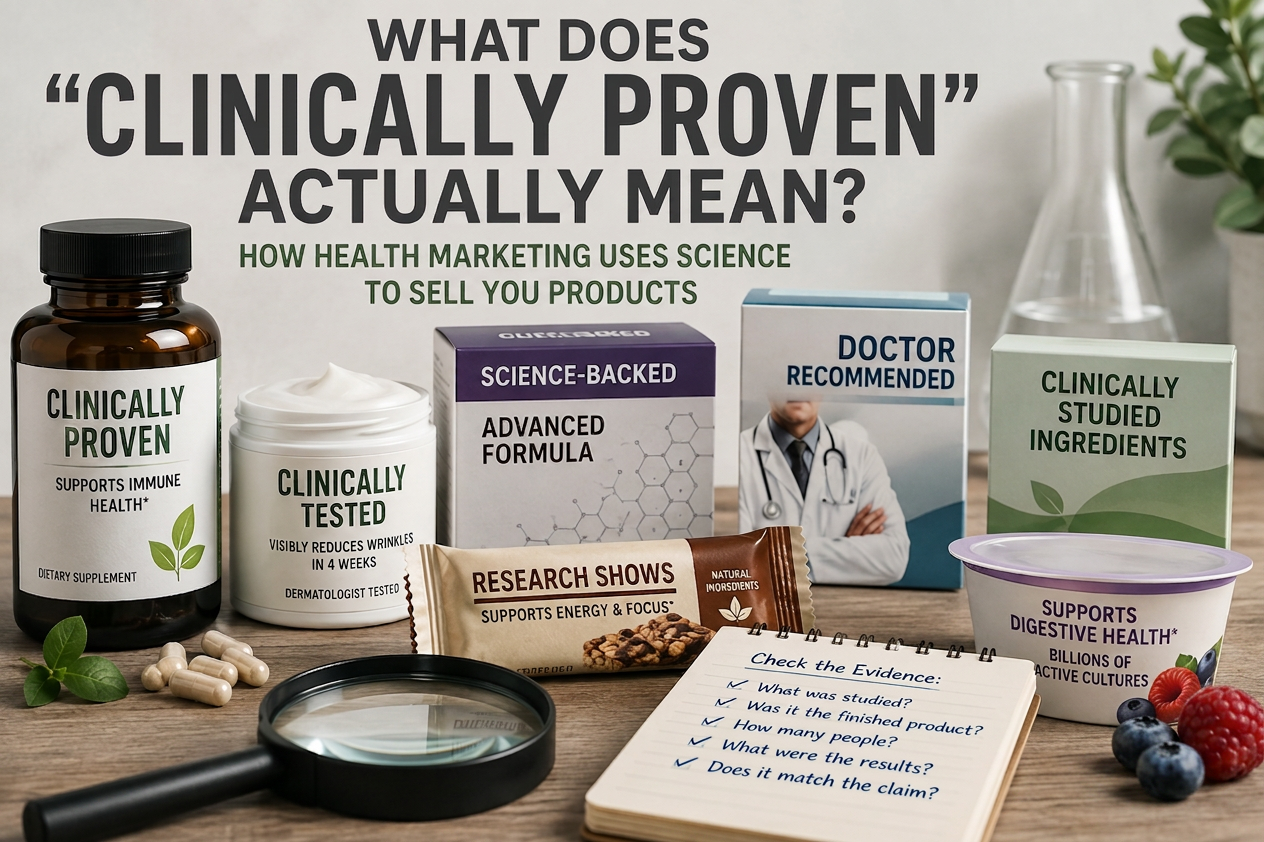
Walk through the supplement aisle, scroll through skincare products, look at a wellness program, or read the package of the newest “healthy” food and you will see the same reassuring phrases everywhere. Clinically proven. Doctor recommended. Science-backed. Research shows. Clinically studied. Those words sound authoritative because they create the impression that somebody has already tested the product, confirmed that it works, and settled the question for you.
But scientific-sounding language and strong scientific evidence are not necessarily the same thing. The Federal Trade Commission requires health-related advertising claims to be truthful, not misleading, and supported by appropriate evidence. Its Health Products Compliance Guidance¹ explains that the entire impression created by an advertisement matters, including claims the advertisement implies rather than states directly. A company can create an impression of scientific proof through wording, graphs, medical imagery, technical terminology, or references to research without ever explicitly saying, “Science proves this product works.”
That does not mean every company using these phrases is misleading you. Supplements, skincare ingredients, foods, herbs, and health programs can have legitimate research behind them. The important question is whether that evidence actually supports what the marketing leads you to believe. Once you know what these phrases tell you, and what they leave unanswered, you can evaluate the evidence instead of relying on the wording printed on the package.
What Does “Clinically Proven” Actually Tell You?
Most people reasonably interpret clinically proven to mean that researchers tested the product in people under controlled conditions and demonstrated that it works. But those two words alone tell you very little about the research. A clinical study might include hundreds of participants, or only a handful. It might compare the product with a placebo, randomly assign participants to groups, and use methods designed to reduce bias. Or it might simply observe what happens when a group of people uses a product.
Randomized controlled trials can provide particularly useful evidence when researchers want to determine whether an intervention caused an observed result. Random assignment helps make treatment groups more comparable and reduces the likelihood that differences between those groups explain the outcome. This is why Randomised Controlled Trials: The Gold Standard for Effectiveness Research² describes randomized controlled trials as a particularly strong design for evaluating effectiveness.
Even then, clinically proven leaves one enormous question unanswered: What exactly did researchers test? Was it the finished bottle sitting on the shelf, or was it one ingredient contained somewhere in the formula? That distinction can completely change what the research actually tells you.
“Clinically Studied” Is Not the Same as “Clinically Proven”
Clinically studied literally tells you that researchers studied something in a clinical setting. It doesn’t tell you whether the study produced positive results, whether researchers designed it well, whether other studies replicated the findings, or whether the results were large enough to matter. A legitimate clinical study can conclude that a product did not work.
Sometimes researchers clinically study an ingredient rather than the finished product the company advertises. The FTC discusses this problem when explaining clinically tested ingredients³ and notes that consumers may interpret such wording to mean both that the ingredient produced the advertised benefit and that the finished product containing it will do the same. Research on an isolated ingredient may not establish that a different finished formulation produces the same result.
Suppose researchers studied 600 milligrams of a standardized herbal extract each day, but the supplement you are considering contains 75 milligrams of a different extract mixed with several other ingredients. The company may truthfully say researchers have clinically studied the herb. That does not mean researchers proved that its particular supplement produces the same result. Dose, preparation, extraction method, formulation, and the finished product itself can matter.
“Science-Backed” Can Mean Almost Anything
Science-backed may be one of the most persuasive phrases in health marketing because it sounds very specific while telling you surprisingly little. Science includes laboratory experiments, animal studies, observational research, pilot studies, controlled human trials, systematic reviews, and many other forms of investigation.
These forms of research answer different questions. NCCIH’s explanation of types of health research⁴ shows why findings from laboratory or animal research cannot simply be treated as proof that the same effect occurs in people. Laboratory research can help scientists understand mechanisms and identify ideas worth investigating. Human studies are needed to determine whether an intervention actually produces the expected effects in people.
So when you see science-backed, ask: What kind of science? A skincare ingredient may affect cultured cells in a laboratory, but that does not prove that a cream containing a small amount of it visibly changes human skin. An herb may have an interesting biological mechanism without yet having enough human evidence to establish the benefit being advertised. The existence of research is the beginning of the question, not the answer.
Why Study Designed Matters for “Clinically Proven” Claims
Even when a company provides a real human study, you still need to know how that study was conducted. Research comparing people who voluntarily use a product with people who do not may reveal an interesting association, but those groups could differ in many other ways. A controlled trial can help researchers separate the effect of the intervention from other factors.
Expectations can influence results too, particularly when participants report subjective changes such as pain, mood, sleep, energy, or skin appearance. Researchers use methods such as randomization and blinding to reduce some of those influences. NCCIH discusses why these safeguards matter in minimizing bias in clinical research⁵, including how keeping participants or researchers unaware of treatment assignments can reduce the influence of expectations in appropriate studies.
This is why a dramatic percentage printed across an advertisement means very little without context. “87% improvement” sounds impressive. But 87% improvement in what? Compared with what? How many people participated in the study? What method did researchers use to measure improvements? A number can be completely accurate and still tell you very little until you understand what was actually measured.
The Number of People Studied Matters Too
A beautifully designed product page may display graphs, percentages, before-and-after photographs, and a large CLINICALLY PROVEN heading. Then you find the study and discover that 18 people participated. That does not automatically make the research worthless. Small preliminary studies can be useful, particularly when researchers are exploring a new idea, but they generally cannot carry the same weight as larger, well-designed studies.
The number of participants affects what researchers can reasonably conclude. NCCIH explains that study sample size⁶ can affect the reliability of findings because smaller studies are more vulnerable to inconclusive results or findings that occurred by chance. Larger studies can provide more precise estimates and may better represent the population researchers want to understand when the rest of the research design is sound.
Who participated matters just as much. Research involving 20 healthy adults in their twenties does not necessarily show that the product works for older adults, children, people taking medications, or people with chronic health conditions. When the marketing expands the claim beyond the population actually studied, an important piece of the scientific evidence has disappeared.
“Research Shows” Requires One More Question
Research shows sounds definitive, but the phrase is incomplete until you ask, “Research shows what?” A study may show that an ingredient changed a laboratory marker without showing that people actually felt or functioned differently. Researchers may find a statistically significant change that is too small to make a meaningful difference in everyday life. A study can also contain several outcomes, some positive and some negative, while an advertisement highlights only the most attractive one.
This is where reading the actual findings becomes important. NCCIH’s guide to understanding scientific results⁷ explains how the results section reports what researchers found and how those findings were analyzed. Looking at those results allows you to compare what the research actually found with the much simpler statement uses to sell the product.
Imagine that researchers primarily designed a study to determine whether a product helped people lose weight. The primary outcome showed no meaningful difference, but one secondary metabolic marker improved slightly. “Research shows metabolic improvement” may refer to a genuine finding while creating a very different impression from the complete study. Technically accurate language can still exaggerate what the research demonstrated when important context is removed.
One Study Is Rarely the Final Answer
A single study can be promising, surprising, or important. It usually should not be treated as the final word. Scientific confidence grows when findings can be reproduced, different researchers investigate the same question, and multiple well-designed studies begin pointing in the same direction.
That is why you should look beyond the study highlighted by the company. NCCIH recommends considering how findings fit with previous research when interpreting scientific conclusions⁸. Researchers themselves commonly discuss limitations, conflicting evidence, unanswered questions, and whether more research is needed. Those qualifications often disappear when the research reaches a product advertisement.
A company can accurately say early evidence is promising when that is what the evidence shows. The problem begins when “promising” becomes “proven,” or when one favorable study is presented as though it settled the question.
“Doctor Recommended” Is an Endorsement, Not a Clinical Trial
There is a meaningful difference between your own healthcare professional recommending something after considering your individual circumstances and the words doctor recommended appearing on a package. The marketing phrase does not tell you how many doctors were asked, what question they answered, whether they reviewed the product’s research, or whether they had a financial relationship with the company.
The FTC requires endorsements used in advertising to follow truth-in-advertising standards, and certain relationships between endorsers and companies may need to be disclosed. Its guidance on advertising endorsements⁹ also makes clear that an endorsement does not remove the advertiser’s responsibility to have appropriate evidence supporting the underlying claim.
A physician in a white coat can make an advertisement feel more credible. That visual impression does not replace product-specific evidence. The same applies to dermatologist recommended, nutritionist approved, or formulated by doctors. Credentials may tell you something about the person involved, but they do not tell you whether the finished product has been demonstrated to do what the advertisement promises.
“Clinically Proven” Claims on Supplement Labels
Many consumers understandably assume that if a health claim appears on a supplement bottle legally sold in the United States, FDA must have reviewed and approved that particular claim before the product reached the shelf. That is not how many dietary supplement claims are regulated.
FDA recognizes several categories of statements, including health claims, nutrient-content claims, and structure/function claims. Its explanation of food and dietary supplement label claims¹⁰ distinguishes among these categories because they do not all go through the same regulatory process. Structure/function claims can describe how a nutrient or dietary ingredient affects normal body structure or function. Familiar phrases such as “supports immune health” or “helps maintain healthy joints” may fall into this category.
Structure/function claims on dietary supplements are not individually preapproved by FDA before appearing on the label. Manufacturers are responsible for having substantiation that the claims are truthful and not misleading. FDA’s requirements for structure/function claims¹¹ also explain the notification and disclaimer requirements that apply to these statements. The presence of a claim on a supplement bottle therefore does not mean FDA independently reviewed the company’s research and concluded that the product works.
What Does the FDA Disclaimer Actually Mean?
Most of us have seen the familiar statement saying the Food and Drug Administration has not evaluated a supplement claim and the manufacturer does not intend the product to diagnose, treat, cure, or prevent disease. It appears so frequently that it is easy to stop noticing it. Yet those words tell you something important about the claim being made.
FDA explains in its Questions and Answers on Dietary Supplements¹² that certain dietary supplement claims do not require FDA approval before manufacturers use them. The manufacturer remains responsible for the claim and its substantiation, but the disclaimer tells you that FDA itself has not evaluated that statement.
That does not automatically mean the claim is false or that the product has no evidence behind it. It means you should not interpret the statement on the bottle as an FDA determination that clinical evidence proves the product effective. Those are very different things.
Skincare Uses the Same Scientific Language
Skincare marketing has become increasingly scientific in appearance. Clinically tested. Dermatologist tested. Collagen supporting. Cellular renewal. Clinically measured wrinkle reduction. Some products contain ingredients with legitimate research behind them, but scientific vocabulary can make a cosmetic sound as though the finished product has undergone far more testing than it actually has.
FDA distinguishes cosmetics from drugs partly according to their intended use and the claims made for them. A product intended to moisturize skin and temporarily improve the appearance of fine lines may be a cosmetic, while certain claims about affecting the structure or function of skin can change its regulatory status. FDA’s discussion of wrinkle treatments and anti-aging products¹³ illustrates why the actual wording of those claims matters.
Ingredient research and finished-product research should not be confused here either. Evidence that an ingredient affects a particular biological pathway does not automatically prove that every cream containing that ingredient produces a visible clinical benefit. Concentration, formulation, stability, delivery, and what researchers actually measured can all affect whether the research applies to the product you are considering.
“Registered on ClinicalTrials.gov” Does Not Mean Government Approved
ClinicalTrials.gov is a useful research database, and seeing a study registered there can provide information that might otherwise be difficult to find. You may be able to see who sponsored a study, what researchers planned to measure, how many participants were enrolled, and whether results have been reported.
Registration itself, however, is not a government seal of approval. The National Library of Medicine explains in About ClinicalTrials.gov¹⁴ that the U.S. government does not review or approve the safety and science of every study listed in the database. Sponsors and investigators submit the information and remain responsible for its accuracy.
That does not make ClinicalTrials.gov less useful. It makes it useful for the right reason. If a company proudly says it registered its study there, look it up. Compare what the researchers planned to investigate with what the company is now claiming the research proved.
How to Check “Clinically Proven” Claims for Yourself
You do not need a science degree to investigate a health claim. Start with the company’s own words. If it says clinically proven, look for the clinical study. If it says research shows, look for the research. If a company repeatedly refers to science but provides no citation and you cannot determine what evidence it is talking about, that is useful information too.
PubMed is one place to search because it contains millions of citations to biomedical research. NCCIH provides instructions for finding complementary health research on PubMed¹⁵, including ways to search for particular health approaches and different kinds of studies. Search the finished product name first and then its important ingredients. You may quickly discover whether the advertised “clinical research” belongs to the actual formula or merely to one ingredient contained in it.
Once you locate the research, compare it with the product. Did researchers use the same ingredient? The same extract? The same amount? Did researchers test finished product? How many people participated? How long did the study last? What outcome did researchers measure? Who funded the research? Most importantly, does the conclusion of the paper actually resemble the promise being made in the advertisement?
Good Evidence Should Survive Questions
None of these marketing phrases, including clinically proven, should automatically convince you that a product works, but they should not automatically make you reject it either. Some companies have invested in legitimate research and describe their evidence accurately. Others take preliminary findings, ingredient studies, small trials, or carefully selected statistics and stretch them into something much more impressive.
The difference becomes easier to see when you ask specific questions. What did researchers study? Was it the finished product? How did the dose compare with the product being sold? Did the study include humans? Was there a control group? How many people participated? Was the result meaningful? Have other researchers found something similar? Those questions move your attention away from the front of the package and toward the evidence behind it.
Proverbs 18:17 reminds us that the first account can seem right until someone examines it. That principle fits health information remarkably well. A convincing claim deserves examination, especially when someone is asking you to spend your money or make a decision about your health.
The next time a supplement, skincare company, wellness program, food manufacturer, or advertisement tells you something is clinically proven, do not stop at the phrase. Ask to see the evidence, then find out whether the evidence actually proves what the marketing says it proves.
Work With Charlotte
If you are trying to sort through conflicting health information, understand patterns in your symptoms, or make sense of the products and approaches you are considering, I can help you look at the bigger picture. My work focuses on helping you become the historian of your own health by examining your history, symptoms, nutrition, lifestyle, and other factors together rather than treating one isolated piece of information as the entire story.
Learn more about working with me through the Work With Charlotte page.
Herbally and Holistically yours,
Charlotte Lange, CNC
CPL Holistics | CPL Botanicals.
Resources
- Federal Trade Commission. Health Products Compliance Guidance. December 2022.
https://www.ftc.gov/business-guidance/resources/health-products-compliance-guidance - Hariton E, Locascio JJ. Randomised controlled trials: the gold standard for effectiveness research. BJOG. 2018;125(13):1716.
https://pubmed.ncbi.nlm.nih.gov/29916205/ - Federal Trade Commission. Health Products Compliance Guidance. Claims involving clinically tested ingredients.
https://www.ftc.gov/business-guidance/resources/health-products-compliance-guidance - National Center for Complementary and Integrative Health. How To Make Sense of a Scientific Journal Article: Types of Research.
https://www.nccih.nih.gov/health/know-science/how-to-make-sense-of-a-scientific-journal-article/methods/types-of-research - National Center for Complementary and Integrative Health. How To Make Sense of a Scientific Journal Article: Minimizing Bias.
https://www.nccih.nih.gov/health/know-science/how-to-make-sense-of-a-scientific-journal-article/methods/minimizing-bias - National Center for Complementary and Integrative Health. How To Make Sense of a Scientific Journal Article: Size of the Study.
https://www.nccih.nih.gov/health/know-science/how-to-make-sense-of-a-scientific-journal-article/methods/size-of-the-study - National Center for Complementary and Integrative Health. How To Make Sense of a Scientific Journal Article: Results.
https://www.nccih.nih.gov/health/know-science/how-to-make-sense-of-a-scientific-journal-article/results - National Center for Complementary and Integrative Health. How To Make Sense of a Scientific Journal Article: Discussion and Conclusion.
https://www.nccih.nih.gov/health/know-science/how-to-make-sense-of-a-scientific-journal-article/discussion-conclusion - Federal Trade Commission. Advertisement Endorsements.
https://www.ftc.gov/news-events/topics/truth-advertising/advertisement-endorsements - U.S. Food and Drug Administration. Label Claims for Conventional Foods and Dietary Supplements.
https://www.fda.gov/food/nutrition-food-labeling-and-critical-foods/label-claims-conventional-foods-and-dietary-supplements - U.S. Food and Drug Administration. Structure/Function Claims.
https://www.fda.gov/food/nutrition-food-labeling-and-critical-foods/structurefunction-claims - U.S. Food and Drug Administration. Questions and Answers on Dietary Supplements.
https://www.fda.gov/food/information-consumers-using-dietary-supplements/questions-and-answers-dietary-supplements - U.S. Food and Drug Administration. Wrinkle Treatments and Other Anti-aging Products.
https://www.fda.gov/cosmetics/cosmetic-products/wrinkle-treatments-and-other-anti-aging-products - National Library of Medicine. About ClinicalTrials.gov.
https://clinicaltrials.gov/about-site/about-ctg - National Center for Complementary and Integrative Health. How To Find Information About Complementary Health Approaches on PubMed.
https://www.nccih.nih.gov/health/how-to-find-information-about-complementary-health-approaches-on-pubmed
Leave a Reply