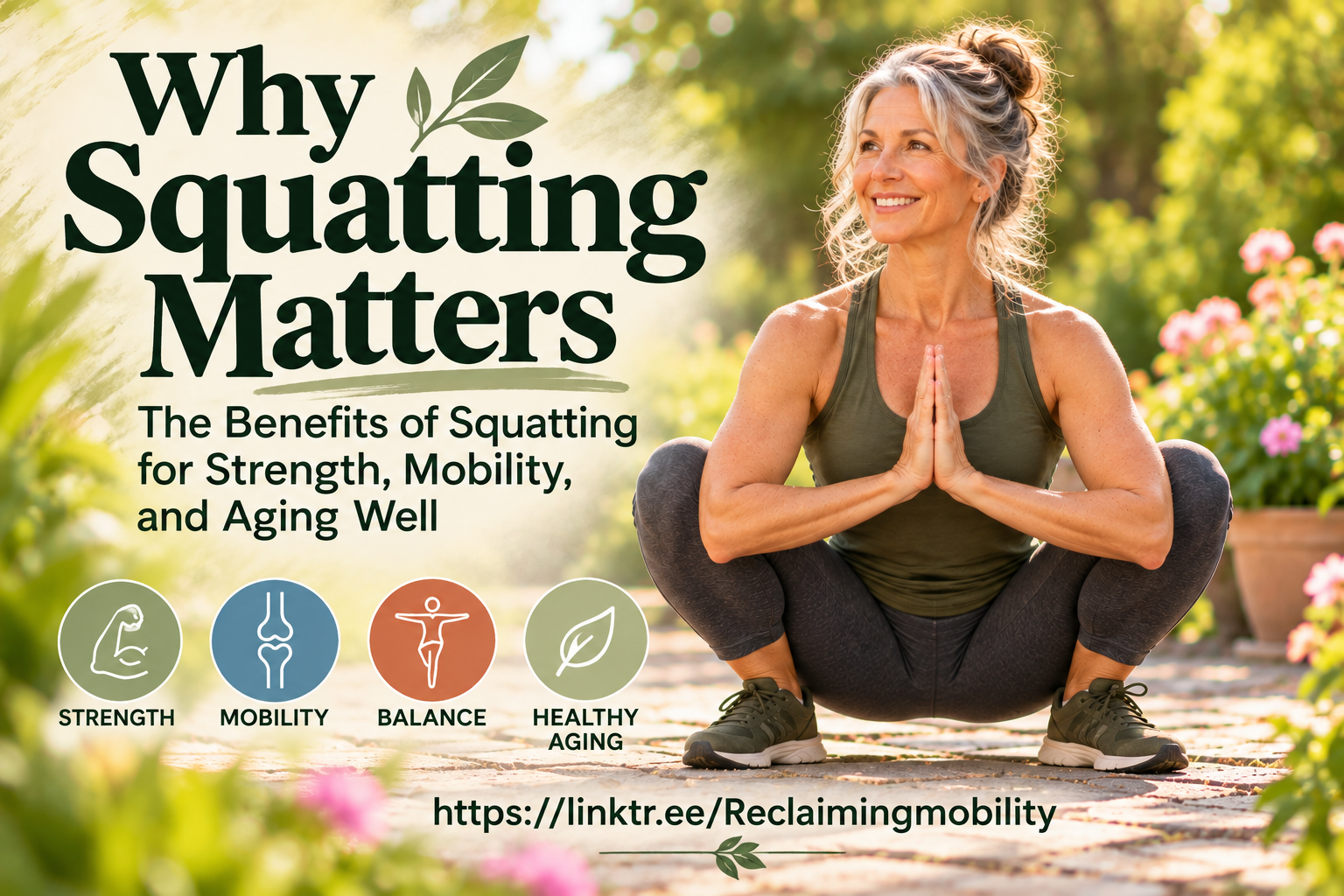
Squatting sounds simple until you actually try it. Can you lower yourself into a deep squat right now, keep your feet flat, and get back up again? Many of us have slowly stopped using movements that once came naturally. We sit in chairs instead of lowering toward the floor. We use our hands to push ourselves up and avoid positions that feel difficult. Eventually, we may discover that a movement we once took for granted no longer feels natural.
That is why I chose squatting to begin October’s Movement Month. Participating in the MovesMethod 30-Day Squat Challenge, and it has made me pay closer attention to my own movement. I did not begin by dropping into a perfect deep squat and comfortably staying there. At times I sometimes leaned too far forward and caught myself holding my breath. Keeping my feet completely flat was not always automatic, either. Instead of treating those things as failures, I started seeing them as information about where my body was starting.
The benefits of squatting reach beyond having strong legs or performing an exercise at the gym. Squatting involves strength, mobility, balance, coordination, and joint control. It also requires us to lower and raise our own body. The WHO physical activity guidelines¹ emphasize muscle strengthening and activities that support functional balance as we age. A squat is only one movement, but it gives us an interesting window into several abilities we use throughout everyday life.
Squatting Is a Human Movement, Not Just an Exercise
Most people hear “squat” and picture someone in a gym with a barbell across the shoulders. Yet squatting existed long before gyms, fitness programs, or exercise classes. We use versions of the movement when we sit down, stand up, garden, or lower ourselves toward the floor. We also use it when reaching into a low cabinet or getting on and off the toilet. Researchers describe the squat movement pattern² as important for many activities of daily living.
A squat requires several areas of the body to cooperate. Your ankles need enough movement to allow your lower legs to move appropriately. Your knees bend while the hips flex and move backward and downward. Meanwhile, your trunk helps maintain control. Muscles throughout your legs, hips, feet, and core respond as the position of your body changes. Research also shows that there is not one universal squat position that every body must copy. Squat biomechanics³ change with stance width, foot rotation, trunk position, shin position, and depth.
Limb lengths, joint structure, previous injuries, mobility, strength, and balance can also influence how someone squats. A squat that looks different from someone else’s squat is not automatically wrong. Instead of chasing somebody else’s picture of a perfect squat, we can ask better questions. What can my body comfortably do today? Where do I feel restricted? Can I control the movement and breathe normally? Can I keep my feet connected with the floor and stand back up? Those observations turn a simple squat into useful information about how the body is moving.
The Benefits of Squatting Begin With Strength
Lowering your body requires muscular control. Getting back up requires enough force to overcome gravity and raise your body weight. The quadriceps help straighten the knees, while the gluteal muscles contribute to hip extension and stability. Muscles around the ankles, hips, pelvis, and trunk also help control the movement. Squatting therefore involves much more than one isolated muscle group.
Maintaining lower-body strength becomes increasingly important as we age. A systematic review involving adults age 75 and older found that resistance training improved strength⁴ in this population. The research included adults over age 80 as well. That does not mean everyone needs heavy weights or a complicated training program. It does show that older muscles can still respond when we give them an appropriate reason to become stronger.
Research continues to support the value of challenging muscles appropriately. A 2026 systematic review examined different resistance-training intensities in adults age 50 and older. Higher-intensity resistance training⁵ produced greater improvements in lower-limb strength than lower-intensity training. Appropriate intensity will vary from person to person, especially when health conditions or previous injuries are involved.
Strength Can Start with the Squatting Movement You Have Today
The important point is that our muscles remain responsive to progressive challenge. Squatting can provide one form of that challenge, and the movement can be modified. Someone may begin by standing from a chair. Another person may perform a partial squat while holding a sturdy support. Someone with more strength and mobility may work toward a deeper squat or eventually add resistance.
The starting point changes, but the underlying principle remains the same. Muscles need to be used if we want them to remain capable. The goal is not to force every person into the same version of a squat. It is to find an appropriate level of challenge and build from there.
How Squatting Helps Preserve the Strength to Stand
Think about how many times you stand during an ordinary day. You rise from the bed, a dining chair, your desk, the couch, the car, and the toilet. You may also stand after gardening or lowering yourself to reach something near the floor. We rarely think about these movements because they happen automatically. That changes quickly when standing up becomes difficult.
Healthcare professionals pay attention to this ability for a reason. The CDC’s STEADI fall-prevention resources include the 30-Second Chair Stand Test⁶. It assesses leg strength and endurance by measuring repeated chair stands. The test is remarkably simple, but the movement provides useful information about lower-body function.
This is where the benefits of squatting become more meaningful to me than simply saying, “I can squat.” I want my legs to remain capable of getting me out of a chair. It is important to me to have enough strength and control to lower myself when I need to. I also want to get closer to the floor and know that I can come back up. Movement becomes less about exercising because we are supposed to exercise and more about preserving useful abilities.
A bathroom scale cannot tell us whether we can rise from the floor. A clothing size cannot measure our ability to control our body when our balance shifts. Neither one tells us how confidently we can move through the physical demands of an ordinary day. Physical function deserves its own place in the way we think about health.
Why Do We Lose Movements Like Squatting?
Children routinely move through positions that many adults eventually find uncomfortable. They squat to play, sit close to the floor, crawl, climb, bend, twist, and constantly change positions. Adults often spend far more time sitting in chairs, working at desks, and repeating a smaller number of movements. Over time, that difference matters because the body responds to the demands we repeatedly place on it.
If we rarely move into a particular position, we stop regularly practicing what that position requires. Strength, mobility, coordination, and confidence can all be affected. That does not necessarily mean the movement is permanently gone. In some cases, we may simply have stopped rehearsing it and gradually become less comfortable there.
Research involving older adults with sarcopenia offers an encouraging example. A 2025 review found that resistance training improved physical function⁷, including knee-extension strength and repeated sit-to-stand performance. The researchers also found limitations in the size of some improvements. That matters because exercise research does not justify miracle claims, but it does support the ability to improve physical capacity.
We should not automatically interpret every movement limitation as an unavoidable consequence of another birthday. Age matters, but it is only part of the picture. Activity, strength, injuries, health conditions, movement habits, and the demands we place on our bodies matter too. We cannot stop aging, but we can continue giving our bodies reasons to remain capable.
What About Squatting and Your Knees?
The knees are probably the biggest reason many people are afraid to squat. Some of us grew up hearing that deep squats were automatically bad for the knees. Others were told that allowing the knees to move forward was dangerous. Research gives us a more nuanced picture, especially when we look at what has actually been studied instead of applying one rule to every person.
A 2024 review examined 15 studies involving deep squatting and knee-joint health. In that review, deep squatting and knee health⁸ were not negatively associated in 14 of the 15 included studies. One case study did associate deep squatting with injury. The researchers concluded that deep squatting appeared safe when performed with appropriate technique.
There is an important limitation. The review focused on resistance-trained individuals. We cannot take those findings and declare that every person with every knee condition should immediately perform deep squats. Someone with an acute injury, significant pain, recent surgery, or instability may need a modified movement. Certain musculoskeletal conditions may also require individualized guidance.
Deeper Squatting Is Not Automatically Better
Squat depth changes the mechanical demands placed on the body. A controlled partial squat that matches your current ability can be more useful than forcing yourself into a deep position. How low another person can squat tells you very little about the depth that is appropriate for your body today.
Pain deserves attention too. Muscles working hard can feel uncomfortable, but sharp or worsening joint pain is different. Movement should help us learn about our bodies rather than teach us to ignore what they are telling us. Depth can develop as strength, mobility, control, and confidence improve.
How Your Ankles Affect Squatting
When someone struggles to squat, attention often goes immediately to the knees. Yet a limitation may begin somewhere else. The ankle must move as the body lowers. If ankle movement is restricted, the rest of the body may compensate to accomplish the movement. That helps explain why some people lift their heels, lean dramatically forward, or turn their feet outward. Others feel as though they are going to fall backward. Those patterns can have several causes, so observing one does not tell us exactly what is wrong. It gives us a clue worth paying attention to.
This was one of the useful parts of doing the squat challenge myself. Early on, keeping my feet completely flat was something I had to think about. By the end of the first week, that had already improved. I was not suddenly performing a perfect squat, and I still could not remain down for thirty minutes at once. However, my relationship with the position had begun changing, and I could see a difference in something that had been difficult only days earlier.
Small improvements are easy to miss when we expect dramatic transformations. Progress may mean getting a little lower or breathing normally instead of holding your breath. Perhaps you stay down another minute. Maybe you realize your heels remain on the floor without constant effort. Those changes may look small from the outside, but they tell us that something is changing.
Squatting Challenges Balance Too
Strength alone does not control a squat. As your body lowers, your center of mass changes. Your nervous system continually makes adjustments to keep you balanced. Information from your feet, joints, muscles, eyes, and inner ear contributes to controlling your position.
Research on resistance exercise has found benefits beyond raw muscular strength. A systematic review concluded that resistance training can improve balance⁹ and some measures of gait in older adults. These improvements can contribute to the physical abilities we need for everyday activities.
That does not mean squatting alone prevents falls. Falls can involve medications, vision, neurological conditions, environmental hazards, blood pressure changes, balance problems, and many other factors. I do not want to turn an association into a claim the research cannot support. Lower-body strength and balance simply belong in the larger conversation about maintaining function.
Movement variety matters for the same reason. Walking is valuable, but walking does not challenge the body exactly like lowering toward the floor or standing from a chair. It also differs from balancing, reaching, stepping sideways, or changing direction. Our bodies have an enormous capacity for movement, and using more of that capacity gives us more opportunities to preserve it.
What About Squatting and Bone Health?
Bone is living tissue, and mechanical loading is one of the signals that influences it. That is one reason resistance exercise frequently appears in discussions about healthy aging and bone health. However, this is an area where we need to be careful about what the evidence actually shows.
A 2022 systematic review examined resistance training and bone mineral density in older adults. The researchers found relatively small changes. They suggested that resistance training and bone health¹⁰ may be more closely connected with preserving bone than dramatically increasing bone density in this population. Other studies have reported more favorable results under different training conditions.
A 2025 systematic review focused specifically on postmenopausal women. In that analysis, resistance training improved bone density¹¹ at the lumbar spine, femoral neck, and total hip. However, results varied among the included studies. Training intensity, frequency, duration, baseline health, nutrition, hormones, and other factors can influence bone responses.
That means I am not going to tell you that sitting in a body-weight squat will build stronger bones. The research does not justify that claim. Appropriately designed resistance exercise belongs in the broader conversation about maintaining muscle and skeletal health as we age. Squatting can be one movement within that larger strategy, but it should not carry claims that the research cannot support.
Deep Squatting Is Not the Starting Line
Social media can make deep squatting look like something everyone should immediately be able to do. One person sits comfortably with the hips close to the heels. Another person cannot lower halfway without tipping backward. Those two bodies may have very different histories, proportions, mobility, strength, and experience. Your starting position is the movement you can control today.
For one person, that might mean standing from a kitchen chair without pushing off with the hands. Another person may hold onto a counter while lowering a few inches. Someone else may already be comfortable in a deep squat but need to improve endurance, breathing, or control. None of those starting points makes the movement meaningless.
We also know that strength training does not require an elaborate gym setup. A 2025 review involving 25 studies and more than 1,300 older adults found that elastic resistance training¹² improved lower-limb strength and balance. Improvements were also seen in functional measures such as chair-standing performance.
Challenge Your Body with Squatting Without Forcing It
There is an important distinction between challenging ourselves and forcing ourselves. Challenge asks the body to gradually do more than it is accustomed to doing. Force ignores pain, control, readiness, and individual limitations. Those are very different approaches.
You do not need to begin with the final version of a movement for that movement to have value. A supported squat, chair stand, or partial squat can still ask your muscles and joints to work. As your body becomes stronger and more comfortable, the movement may change with it.
What the MovesMethod Squat Challenge Is Teaching Me
My interest in squatting became much more personal when I started the MovesMethod 30-Day Squat Challenge. Reading research about movement can teach us a great deal. Actually practicing a movement every day reveals things that no research paper can tell us about our own bodies.
I quickly discovered several things about mine. I sometimes leaned too far forward, and I caught myself holding my breath. My feet did not always stay completely flat at first. The biggest challenge, however, was simply staying in the squat for very long. I could manage a few minutes rather than the longer period I was working toward.
Then things started changing. My feet became more stable, and I became more aware of my breathing and positioning. I also began recognizing the difference between something feeling difficult because it was unfamiliar and something genuinely not feeling right. I am still building my ability to remain in the squat longer, but that is part of why I am doing the challenge.
Why Strength Through Range of Motion Caught My Attention
MovesMethod emphasizes strength through range of motion¹³ as part of its approach to mobility. That concept is one reason the program caught my attention. I am not interested in flexibility simply for the sake of stretching farther. I want movement I can actually use in everyday life, and I want to understand how my body responds while I work toward it.
(Affiliate disclosure: This post may contain affiliate links. I may earn a commission from qualifying purchases at no additional cost to you.)
I am currently participating in the MovesMethod 30-Day Squat Challenge, and the experiences I describe here are my own. If you are interested in the program I am currently using, you can learn more about MovesMethod¹⁴ and decide whether it fits your own movement goals.
Squatting for Thirty Minutes Does Not Have to Happen All at Once
The squat challenge has reminded me how easily we can turn a goal into an all-or-nothing rule. If the ultimate goal is thirty minutes but you can only manage a few minutes at a time, it is tempting to decide that you cannot do it. That approach ignores the value of meeting your body where it is and allowing your ability to develop.
If two minutes is where your body is today, then two minutes gives you a starting point. You can stand, move around, and return to the position later. Over time, you can observe whether those periods become longer or more comfortable. Someone else may need support, while another person may need a shallower position. The goal does not erase the value of the work that happens on the way there.
Progress should be earned gradually rather than forced. The body adapts to repeated demands, but tissues and movement skills need time to respond. Consistency gives us the opportunity to notice those changes. It also allows us to make adjustments when something does not feel right.
Pay Attention to More Than the Clock
I have started paying more attention to what my body is doing instead of concentrating only on the clock. Am I breathing normally? Are my feet flat? Do I feel balanced? Am I forcing myself lower than I can comfortably control?
A timer tells me how much time has passed. Those observations tell me much more about how I moved during that time. They can also show changes that I might miss if the only thing I recorded was the number of minutes I spent squatting.
Squatting Can Become Part of Your Health Journal
If you have followed CPL Holistics | CPL Botanicals for any length of time, you know how strongly I believe in observing patterns. We track food, sleep, symptoms, energy, digestion, medications, supplements, and laboratory results. Yet many of us rarely journal what our bodies can physically do. Movement belongs in that story too.
Try a supported squat or sit-to-stand and pay attention to what happens. How low can you comfortably go? Do your heels stay down? Does one side feel different? Do you hold your breath? Can you rise without using your hands? Write those observations down without judging them. You are creating a record of where your body is today rather than relying on memory weeks or months later.
Repeat the movement after you have practiced consistently for a while. Then compare what you notice. Perhaps your squat is deeper, your feet are more stable, or standing from a chair feels easier. Maybe you simply feel less nervous lowering yourself toward the floor. Those changes can matter even when nothing dramatic has happened on the bathroom scale.
Measure Progress the Scale Cannot See
Research gives us another reason to pay attention to function. Improvements in strength and physical performance¹⁵ do not always occur alongside equally large changes in measured muscle mass. What your body can do matters.
A journal entry that says, “I needed both hands to stand from this chair, and now I can stand without them,” captures progress that a scale could completely miss. The same is true when you notice that you can squat a little lower, maintain your balance more easily, or keep your feet flat without thinking about it.
Those observations give us another way to recognize progress. Instead of relying only on pounds, inches, or laboratory numbers, we can also pay attention to what our bodies are becoming capable of doing.
Reclaim the Movement Instead of Chasing Perfection
The benefits of squatting are not found in creating the prettiest squat for social media. They come from developing the abilities behind the movement. Strength, mobility, balance, coordination, control, and confidence all contribute to how well we move through our daily lives.
You may discover that your squat is limited today. Perhaps your ankles feel stiff or your legs fatigue quickly. You may need support to feel balanced, or you might realize that you have been avoiding lower positions for years. None of those observations requires judgment. They simply give you information about your current starting point.
Start where you are. Use a chair if you need one. Hold onto something sturdy, reduce the depth, or practice standing with control. Give your body an opportunity to become familiar with the movement instead of demanding that it immediately perform the final version.
At the same time, respect what your body tells you. Significant or persistent pain, instability, an acute injury, recent surgery, or a condition affecting movement may require individualized guidance. There is no prize for forcing your body into a position it is not ready to control. Movement should expand our lives rather than become another standard we use to criticize ourselves.
What Is Your Body Telling You When You Squat?
October is Movement Month for CPL Holistics | CPL Botanicals because health involves more than food, supplements, or numbers on a laboratory report. Our ability to move through our lives matters too. The squat gives us a surprisingly simple place to begin exploring that part of our health.
Try standing from a chair without using your hands and notice what happens. If that feels comfortable, explore a slightly deeper squat while holding something stable. Pay attention to your feet, ankles, knees, hips, breathing, balance, and confidence. You are gathering information, not competing with anyone else.
That is what this challenge is teaching me. I am learning where my body is today and where it struggles. I am noticing where it compensates and where it is already improving. Those observations become part of my health history just as surely as numbers written on a laboratory report.
Do not worry about what someone else can do. Pay attention to what you can do today. Then give your body the opportunity to show you what it can learn.
Your body has a story to tell. Go to Work With Charlotte to learn how to become the historian of your own health.
Herbally and Holistically yours,
Charlotte Lange, CNC
CPL Holistics | CPL Botanicals.
References and Resources
- World Health Organization. WHO Guidelines on Physical Activity and Sedentary Behavior. 2020.
https://www.who.int/publications/i/item/9789240015128 - Straub RK, Powers CM. A Biomechanics Review of the Squat Exercise: Implications for Clinical Practice. International Journal of Sports Physical Therapy. 2024.
https://pmc.ncbi.nlm.nih.gov/articles/PMC10987311/ - Straub RK, Powers CM. A Biomechanics Review of the Squat Exercise: Implications for Clinical Practice. PubMed. 2024.
https://pubmed.ncbi.nlm.nih.gov/38576836/ - Grgic J, et al. Effects of Resistance Training on Muscle Size and Strength in Very Elderly Adults: A Systematic Review and Meta-Analysis of Randomized Controlled Trials. Sports Medicine. 2020.
https://pubmed.ncbi.nlm.nih.gov/32740889/ - Effectiveness of High-Intensity Versus Low-to-Moderate-Intensity Resistance Training in Improving Muscle Strength and Bone Mineral Density in Older Adults: A Systematic Review and Meta-Analysis of Randomized Controlled Trials. Geriatrics & Gerontology International. 2026.
https://pubmed.ncbi.nlm.nih.gov/42366614/ - Centers for Disease Control and Prevention. STEADI Clinical Resources: 30-Second Chair Stand Test.
https://www.cdc.gov/steadi/hcp/clinical-resources/index.html - Yan R, et al. Optimal Resistance Training Prescriptions to Improve Muscle Strength, Physical Function, and Muscle Mass in Older Adults Diagnosed With Sarcopenia: A Systematic Review and Meta-Analysis. Aging Clinical and Experimental Research. 2025.
https://pubmed.ncbi.nlm.nih.gov/41212331/ - Rojas-Jaramillo A, et al. Impact of the Deep Squat on Articular Knee Joint Structures, Friend or Enemy? A Scoping Review. 2024.
https://pmc.ncbi.nlm.nih.gov/articles/PMC11618833/ - Keating CJ, et al. Influence of Resistance Training on Gait & Balance Parameters in Older Adults: A Systematic Review. International Journal of Environmental Research and Public Health. 2021.
https://pubmed.ncbi.nlm.nih.gov/33670281/ - Massini DA, et al. The Effect of Resistance Training on Bone Mineral Density in Older Adults: A Systematic Review and Meta-Analysis. Healthcare. 2022.
https://pmc.ncbi.nlm.nih.gov/articles/PMC9222380/ - Optimal Resistance Training Parameters for Improving Bone Mineral Density in Postmenopausal Women: A Systematic Review and Meta-Analysis. 2025.
https://pubmed.ncbi.nlm.nih.gov/40420105/ - Meng Y, et al. Effects of Elastic Band Resistance Training on Lower Limb Strength and Balance Function in Older Adults: A Systematic Review and Meta-Analysis. Frontiers in Sports and Active Living. 2025.
https://pubmed.ncbi.nlm.nih.gov/41278596/ - MovesMethod. Mobility Training and Movement Program.
https://www.movesmethod.com/start - MovesMethod Affiliate Link for Charlotte Lange.
https://movesmethod.com/toolkit-ca?a=charlotte1&utm_source=growi&utm_medium=affiliate&utm_campaign=the-movers&utm_term=charlotte1 - Yan R, et al. Optimal Resistance Training Prescriptions to Improve Muscle Strength, Physical Function, and Muscle Mass in Older Adults Diagnosed With Sarcopenia. Full Text. 2025.
https://pmc.ncbi.nlm.nih.gov/articles/PMC12602684/
Leave a Reply